


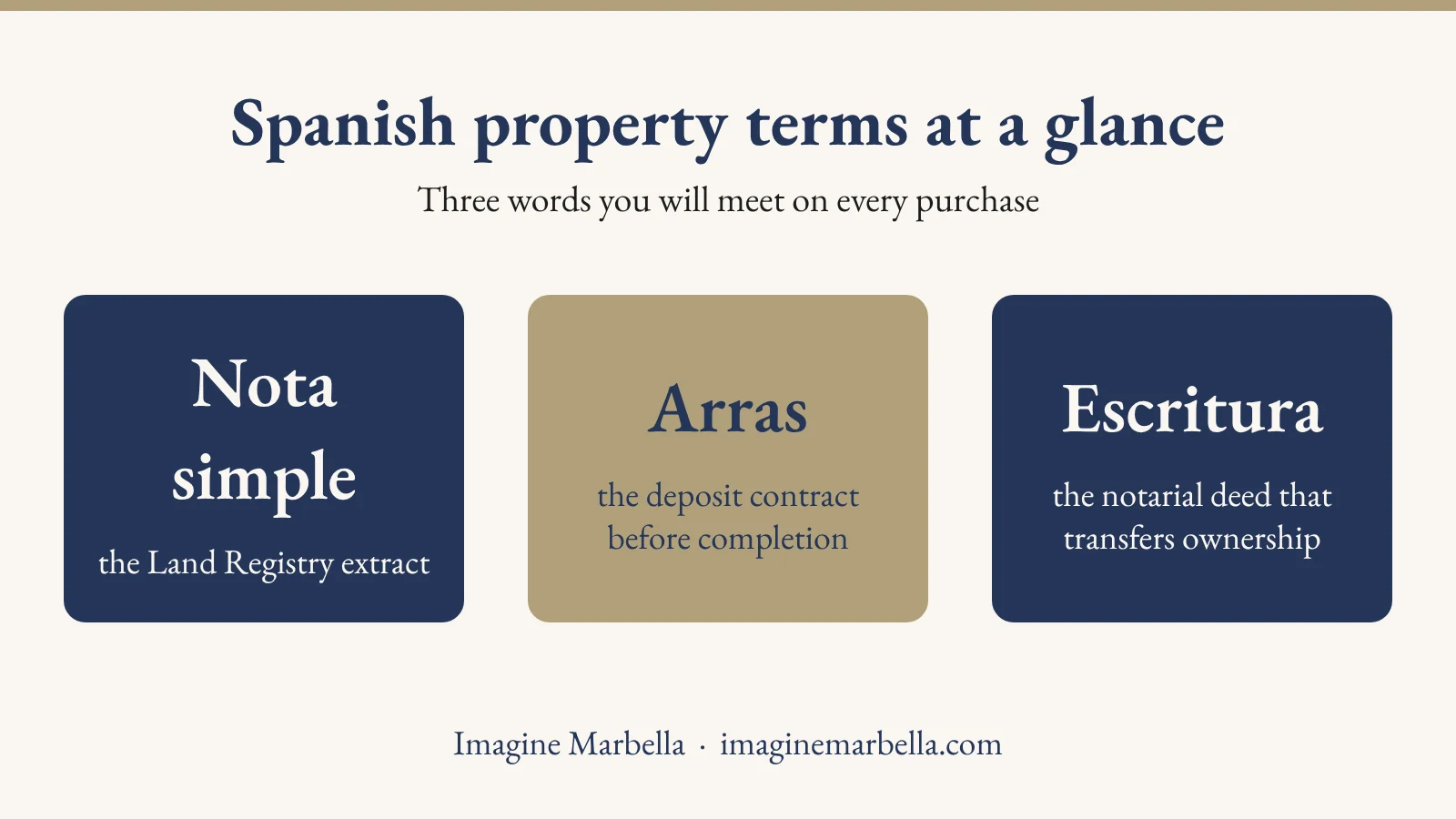
Short answer: a nota simple is the extract from the Spanish land registry: it shows who owns the property and which mortgages or charges are registered against it. With the contrato de arras you secure the purchase with a deposit, and at the notary you sign the escritura, the deed that makes you the owner. You'll find all the other terms below.
In short
- The nota simple is something you request from the Registro de la Propiedad before you sign anything. That way you know the seller really is the owner and what charges there are.
- The contrato de arras is the purchase contract with a deposit, signed between the reservation and the notary.
- The escritura is signed at the notary and then entered in the land registry.
- On a resale property you pay transfer tax (ITP), on a new build you pay VAT (IVA) and stamp duty (AJD).
- You need an NIE , the Spanish identification number for foreigners.
Choose your municipality
Or search by property type
Buying a home on the Costa del Sol is a joy, but the paperwork speaks Spanish. Nota simple, arras, escritura, plusvalía, modelo 210: once you know the words, you can read every document with peace of mind and ask the right questions. This glossary explains each term briefly and accurately, with a link to the guide where you can read more. That way you'll arrive at the notary well prepared.
What is a nota simple and why do you need one?
A nota simple is an informative extract from the Registro de la Propiedad, the Spanish land registry. It's the first document you look at when there's a home you want to buy.
- Who is the owner? The name of the registered owner must match the seller.
- What is being bought? The description of the property, the floor area according to the registry and the share of the communal areas.
- What charges are there? Mortgages, seizures (embargos), easements and other restrictions.
Anyone with a legitimate interest can request a nota simple online from the Colegio de Registradores, and you usually receive it within one working day. It isn't a certified document, but it is the quickest way to check that everything is in order. Just before the notary appointment, your lawyer requests a fresh one to make sure nothing has been added in the meantime. You can read more about these checks in our guide to legal checks when you buy.
What is a contrato de arras?
The contrato de arras is the purchase contract with a deposit (señal) that you sign between the reservation and the notary. It sets out the price, the date of the deed and the conditions. The most common form is the arras penitenciales under article 1454 of the Spanish Civil Code:
- If the buyer pulls out of the purchase, they lose the deposit.
- If the seller pulls out of the purchase, they pay back double the deposit.
That way both parties know where they stand, and the property comes off the market. Before this, you often sign a short reserva (reservation contract) for a smaller amount. Always have the wording of the arras checked before you sign: it also sets out what happens if your mortgage doesn't come through.
What is the escritura and what does the notary do?
The escritura pública de compraventa is the notarial deed that transfers ownership. You sign it before the notario, who checks the identity of the parties, the payment and any charges, and reads the deed aloud. The escritura then goes to the Registro de la Propiedad for inscripción: from that moment you are registered as the owner and protected against all third parties.
Can't travel to Spain yourself? Then you sign through a poder notarial, a power of attorney granted before a notary, with an apostille if it was drawn up outside Spain. The escritura also states the precio escriturado, the price on which the taxes are based.
What are the taxes and costs on a purchase called?
The name depends on what you buy and who collects the tax. These are the terms you'll see on every cost estimate.
| Term | What is it? | When? |
|---|---|---|
| ITP (Impuesto sobre Transmisiones Patrimoniales) | transfer tax, in Andalusia 7% | on a resale property |
| IVA | VAT on a new home, 10% | on the first sale by the developer |
| AJD (Actos Jurídicos Documentados) | stamp duty on the deed, in Andalusia 1.2% | on a new build, on top of the IVA |
| IBI (Impuesto sobre Bienes Inmuebles) | annual municipal property tax; the council sets the rate within 0.4% to 1.1% of the cadastral value | every year, as the owner |
| Plusvalía municipal | municipal tax on the increase in the value of the land | on sale, paid by the seller |
You'll find all the costs at a glance, including notary and land registry, on our page buying costs. You can read how the plusvalía works in our guide to plusvalía when you sell.
What do modelo 210 and modelo 211 mean?
A A modelo is a tax form from the Agencia Tributaria. As the owner of a second home, you're sure to come across two of them.
- Modelo 210: the non-resident income tax return (IRNR). If you don't live in Spain, you use it to declare your rental income, or the deemed income if you use the property yourself. The rate is 19% for residents of the EU and the EEA and 24% for residents of other countries.
- Modelo 211: if you buy from a seller who does not live in Spain, you withhold 3% of the price and pay it to the tax authorities with this form, as an advance on the seller's tax.
You can read all about the annual tax return in our guide tax on your second home in Spain.
What are LPO and AFO, and why do they matter?
Both are about whether the property has been built in line with the rules and can be lived in.
- LPO (licencia de primera ocupación): the town hall document confirming that a new building has been completed in accordance with the building licence and may be occupied. Depending on the municipality, it is also called licencia de ocupación or declaración responsable de ocupación. You need it to connect the water and electricity.
- AFO (asimilado a fuera de ordenación): recognition by the town hall of a building or extension that was built without a licence, but for which the deadline for enforcement action has passed. With an AFO, the property can be legally used and registered, with restrictions on any future works.
For rural homes and villas with extensions, this is a standard part of our checks. That way, you can buy with peace of mind.
What is the comunidad de propietarios?
The comunidad de propietarios is the owners' association of a building or urbanisation, governed by the Horizontal Property Act (Ley de Propiedad Horizontal). It manages the gardens, swimming pools, lifts and security. Every owner pays a cuota, in proportion to their share.
When the property is sold, the seller must provide a certificate from the comunidad confirming that there are no outstanding contributions. Also ask for the latest minutes (actas): they show which works are planned and how well the complex is managed.
Which documents and numbers do you need?
| Term | Explanation |
|---|---|
| NIE (Número de Identidad de Extranjero) | your Spanish identification number as a foreigner, needed for the deed, the bank and taxes. See our guide Apply for NIE number. |
| Referencia catastral | the property's number in the Catastro, the land registry used for tax purposes, which also records the cadastral value (valor catastral). |
| Certificado energético | the energy performance certificate, which the seller must provide when selling. |
| Poder notarial and apostille | a power of attorney granted before a notary and its international legalisation, if you are buying remotely. |
| Padrón (empadronamiento) | registration on your municipality's population register. |
| Aval bancario | the bank guarantee that protects your payments on a property still under construction (buying sobre plano). |
| FEIN | your bank's European information sheet setting out all the terms of the mortgage, before you sign. See mortgages in Spain. |
Glossary from A to Z
| Spanish | Meaning |
|---|---|
| Abogado | lawyer, who carries out the legal due diligence and represents you at the notary |
| Cargas | charges on the property, such as a mortgage or an embargo |
| Gestor / gestoría | an office that handles paperwork and tax returns for you |
| Hipoteca | mortgage |
| Llave en mano | turnkey, ready to move into |
| Obra nueva | new-build property |
| Promotor | the developer of a new build project |
| Reventa / segunda mano | existing home, resale |
| Sobre plano | buying off-plan, before the home has been built |
| Tasación | valuation by a certified surveyor, needed for the mortgage among other things |
| Titular | the registered owner |
| Urbanisation | residential estate or complex with shared amenities |
How does it compare at home? The contrato de arras is close to exchange of contracts in England and Wales, and the escritura signed before the notary is the moment of completion. The Registro de la Propiedad does the job of HM Land Registry (or the Property Registration Authority in Ireland). The big difference: in Spain the notary is a neutral public official, so your own lawyer (abogado) does the searches a conveyancing solicitor would do.
How do we help you with all that paperwork?
As a multilingual estate agency, we explain every document in your own language, from the nota simple to the escritura. We work with lawyers who carry out the legal due diligence, and we sit at the table with you at the notary. With both new builds and resale homes, the seller pays our commission, so there are no agency fees for you. And after the handover of the keys, we're still by your side, with advice on furnishing and interior design. In the meantime, take a look at the apartments and penthouses, the houses and villas or the new developments on the Costa del Sol.
Is there a word in your contract you don't understand, or a property whose nota simple you'd like checked? Send it to us and we'll be happy to explain.
Contact usSend us a WhatsAppRead also: the complete step-by-step guide to buying a house in Spain, the legal checks, applying for an NIE and tax on your second home.
This article is part of our guide to tax and law for property in Spain: all the rules for buying, owning, renting out, selling and inheriting in one place, checked every month.
Frequently asked questions about Spanish property terms
What is a nota simple?
A nota simple is an informative extract from the Spanish Land Registry. It shows you who the registered owner is, how the property is described and which mortgages, embargoes or other charges are registered against it. You can request one online and receive it quickly, so you can move forward with peace of mind.
What happens to the deposit under a contrato de arras?
With the usual arras penitenciales, the buyer loses the deposit if they withdraw from the purchase, and the seller pays back double if they pull out. That way both parties know where they stand, and the property comes off the market. Always have the terms checked beforehand.
What is the difference between the escritura and the nota simple?
The escritura is the notarial deed that makes you the owner. The nota simple is an extract from the registry showing what is recorded there about the property. After signing the deed, your escritura is entered in the registry, and from then on a new nota simple shows you as the owner.
What is the difference between ITP and IVA?
If you buy a resale property, you pay transfer tax (ITP). If you buy a new build directly from the developer, you pay VAT (IVA) plus stamp duty (AJD) on the deed. You never pay both: the type of property determines which tax applies.
Do I need an NIE to buy a property in Spain?
Yes. As a foreigner you need an NIE to sign the deed, open a Spanish bank account and pay your taxes. You can apply for it in Spain or through the Spanish consulate. We're happy to help you sort it out in good time, so your purchase goes smoothly.
Sources
- Código Civil, article 1454 (arras), BOE, accessed 19 November 2026
- Ley 49/1960 de Propiedad Horizontal, BOE, accessed 19 November 2026
- Colegio de Registradores de España (nota simple), accessed 19 November 2026
- Junta de Andalucía, ITP y AJD, accessed 19 November 2026
- Non-Resident Income Tax Act (TRLIRNR), BOE, accessed 19 November 2026
- Local Taxes Act (IBI and plusvalía), BOE, accessed 19 November 2026
Imagine Marbella editorial team. Last checked: 19 November 2026. General information only, not legal or tax advice: always have your situation reviewed by a lawyer or gestor.