



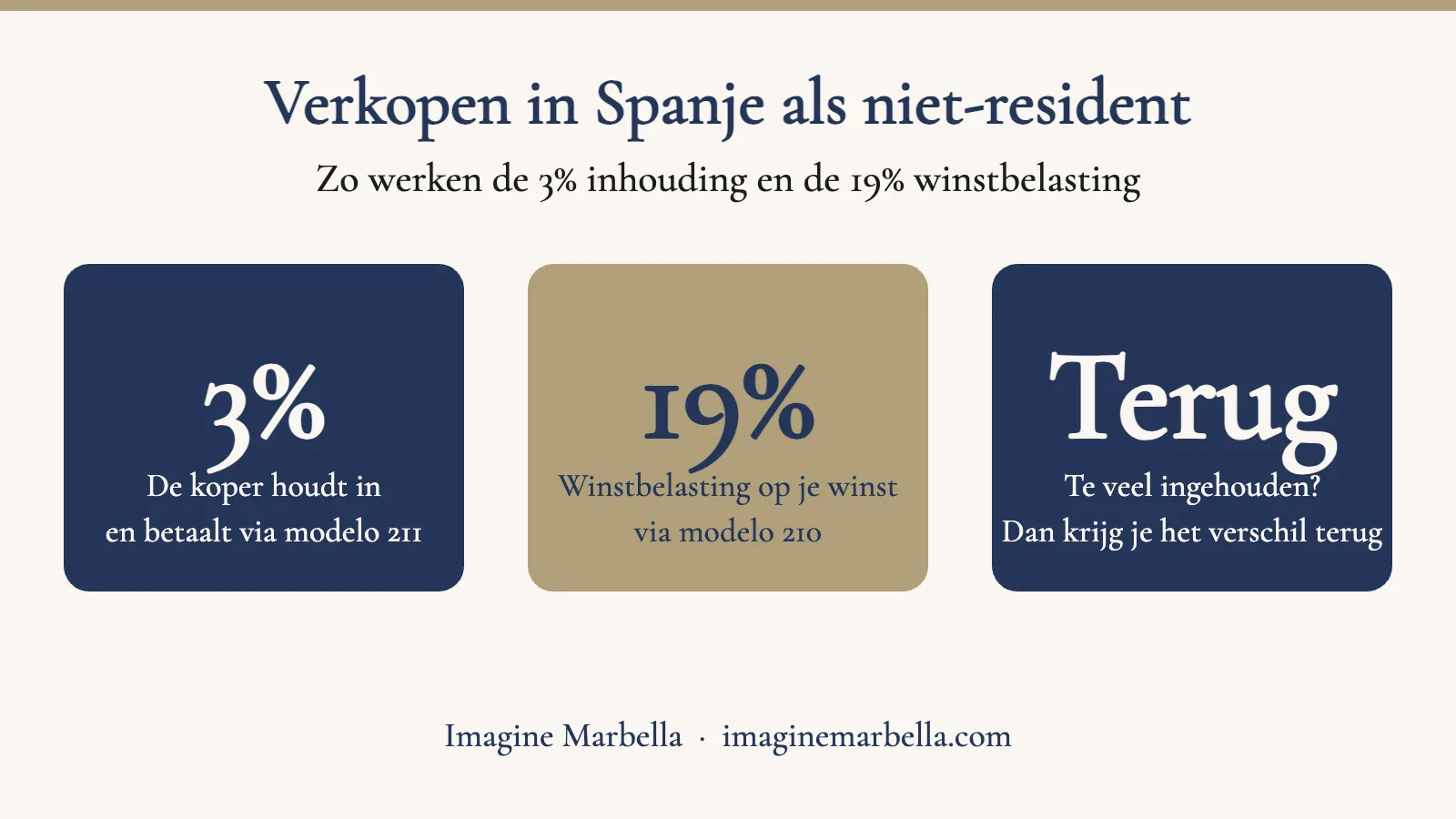
Short answer: if you don't live in Spain and sell a property there, this is broadly what happens. (1) The buyer withholds 3% of the sale price and pays it to the Spanish Tax Agency with modelo 211. (2) You declare your gain with modelo 210 and pay 19% on it. (3) The 3% is an advance: if your actual tax is lower, you get the difference back. The municipal plusvalía comes on top. Below you'll see how it works, with a worked example.
You own a home on the Costa del Sol, you live in the UK, Ireland, Belgium, the Netherlands or France, and you're thinking of selling. The obvious question is: what will I keep? The rules are clear, the deadlines are known and you can prepare everything properly. Here's the full picture, without legal jargon.
Why does the buyer withhold 3%?
Spain wants to be sure it collects tax from sellers who leave the country. That's why at the deed the buyer withholds 3% of the agreed sale price and pays it to the Spanish Tax Agency (Agencia Tributaria). This is done with modelo 211, within one month of the sale. The buyer gives you the proof of payment, which you'll need later.
Important to remember: the 3% is calculated on the price, not on your gain. So it's an advance on your actual tax, not the final bill. At the notary you therefore receive 97% of the price. The other 3% goes to the tax authorities, and sometimes you get part of it back. More on that below.
How much tax do you actually pay?
On your gain you pay as a non-resident 19%. That rate is set in the Spanish Non-Resident Income Tax Act and applies to all non-residents, including sellers from the United Kingdom since Brexit. The higher 24% rate applies to other income, such as rental income, not to the gain on a sale.
You calculate your gain as follows:
| Item | What counts |
|---|---|
| Sale value | sale price minus the costs you paid as seller (agent, plusvalía, mortgage cancellation, community certificate) |
| Purchase value | purchase price plus purchase costs (tax, notary, Land Registry, lawyer) plus documented improvements |
| Gain | sale value minus purchase value |
| Tax | 19% of the gain |
Ordinary maintenance (painting, small repairs) usually doesn't count. Structural improvements (a pool, an extension, a new kitchen with an invoice) do. Mortgage interest is not deductible. So keep your invoices and bank statements; without proof the tax authorities can refuse the deduction.
Worked example
Say you bought an apartment for 300,000 euros, with 30,000 euros in purchase costs and documented improvements. You sell it for 450,000 euros and pay 20,000 euros in agent fees and plusvalía. (The example is fictional, to show how it works.)
| Step | Amount |
|---|---|
| Sale value (450,000 minus 20,000) | 430.000 |
| Purchase value (300,000 plus 30,000) | 330.000 |
| Gain | 100.000 |
| Tax at 19% | 19.000 |
| Withheld by the buyer (3% of 450,000) | 13.500 |
| Still to pay with modelo 210 | 5.500 |
And if you sell at a loss or with no gain? Then you reclaim the full 3% withheld via modelo 210. For example, if you sell for 380,000 euros a property you bought for 400,000 euros, 11,400 euros comes back to you. Note: refunds can take months, so allow for that in your budget.
Modelo 210: your return, step by step
You declare your gain with modelo 210, even if there is no gain. The deadline is three months, counted from the end of the month the buyer had to pay modelo 211. In practice you file roughly between one and four months after the sale. Put that deadline in your diary straight away.
- Gather your documents: purchase deed, improvement invoices, the sale deed and proof of modelo 211.
- Calculate your gain as in the table above.
- File modelo 210 (most people have a gestor or tax adviser do it) and pay the difference, or claim your refund.
- Keep everything for at least four years. After that the tax authorities can no longer reopen that year.
What about exemptions?
The well-known exemptions, such as for over-65s or for reinvesting in a main residence, apply to selling a property that was your main home in Spain. They don't apply to a non-resident's second home. If you're unsure about your situation, have it checked by a tax adviser.
And in your home country?
Under the tax treaties, Spain may tax the gain on a Spanish property. What else applies in your home country depends on your situation and the country. The treaty usually ensures you don't pay twice. Live in the United Kingdom? The rate on your gain stays 19%, even after Brexit. The UK usually credits the Spanish tax against your UK bill, up to the amount you would pay in the UK. Have this checked by an adviser at home to avoid surprises in your return. We're happy to introduce you to English-, Dutch- and French-speaking advisers on the Costa del Sol.
How to avoid the classic mistakes
- Ask for proof of modelo 211. Have it stated in the deed that the buyer pays the 3% and gives you the proof. Without proof you can't offset the withholding.
- Keep all your invoices from the purchase and improvements. This is money.
- Don't forget the plusvalía. It's a separate municipal tax: read all about the plusvalía municipal.
- Review all the costs beforehand. There's an overview in the costs of selling.
- Don't lose sight of the modelo 210 deadline.
How we help
We guide owners from the UK, Belgium, the Netherlands and France who sell remotely. We calculate your net proceeds in advance, keep track of the notary, buyer and gestor timetable and speak your language. We've been working from Marbella and Benahavís since 2018. What is your property worth, and what will you keep? Ask for a free valuation or send us a WhatsApp message. No strings attached.
Want to know what your property is worth and what you keep after tax and costs? We calculate it for free. No strings attached.
Free valuationSend us a WhatsAppRead also: selling a villa in Marbella, selling your property on the Costa del Sol and mortgages in Spain.
This article is part of our guide to tax and law for property in Spain: all the rules for buying, owning, renting out, selling and inheriting in one place, checked every month.
Free sellers' guide 2026
Selling your property in Spain
- The sales process step by step
- The documents you need
- All costs and taxes when selling
- How to get the best price
You get the guide straight away on screen and in your inbox. No spam.
Frequently asked questions
As a non-resident, is 3% always withheld?
Yes, if you're not tax resident in Spain, the buyer withholds 3%. It's an advance on your tax, not the final amount.
Who pays the 3% to the tax authorities?
The buyer, with modelo 211 within one month of the sale. You receive the remaining 97% at the notary.
How much capital gains tax do I pay?
19% of your gain, after deducting purchase costs, documented improvements and selling costs. This also applies to sellers from the United Kingdom.
When do I declare my gain?
With modelo 210, within three months after the buyer's month to pay modelo 211 has ended. Even if you sell at a loss.
Do I get the 3% back?
Yes, to the extent it exceeds the tax you actually owe. With a loss you get it all back. Expect some waiting time.
Do I also pay plusvalía?
Yes. It's a municipal tax on the rise in land value, separate from capital gains tax. You pay it to the town hall where the property is located.
Can I sell if I do not live in Spain?
Yes. With a power of attorney signed before a notary, someone can sign the deed for you. We arrange this together with your lawyer.
Sources
- Real Decreto Legislativo 5/2004 (Non-Resident Income Tax Act), article 25: 19% rate on capital gains (boe.es)
- Agencia Tributaria, modelo 210 instructions (sede.agenciatributaria.gob.es)
- Notarios y Registradores, Tributación de ganancias inmobiliarias por no residentes
- DIG, Retención del 3 % y modelo 211 al vender siendo no residente
- Pellicer & Heredia, Impuesto sobre las ganancias patrimoniales en España 2026
- idealista news, Los impuestos y gastos por vender una vivienda en 2026
Written by the Imagine Marbella editorial team. Updated October 2026. This is general information, not tax advice: always have your situation checked by a gestor or tax adviser.