



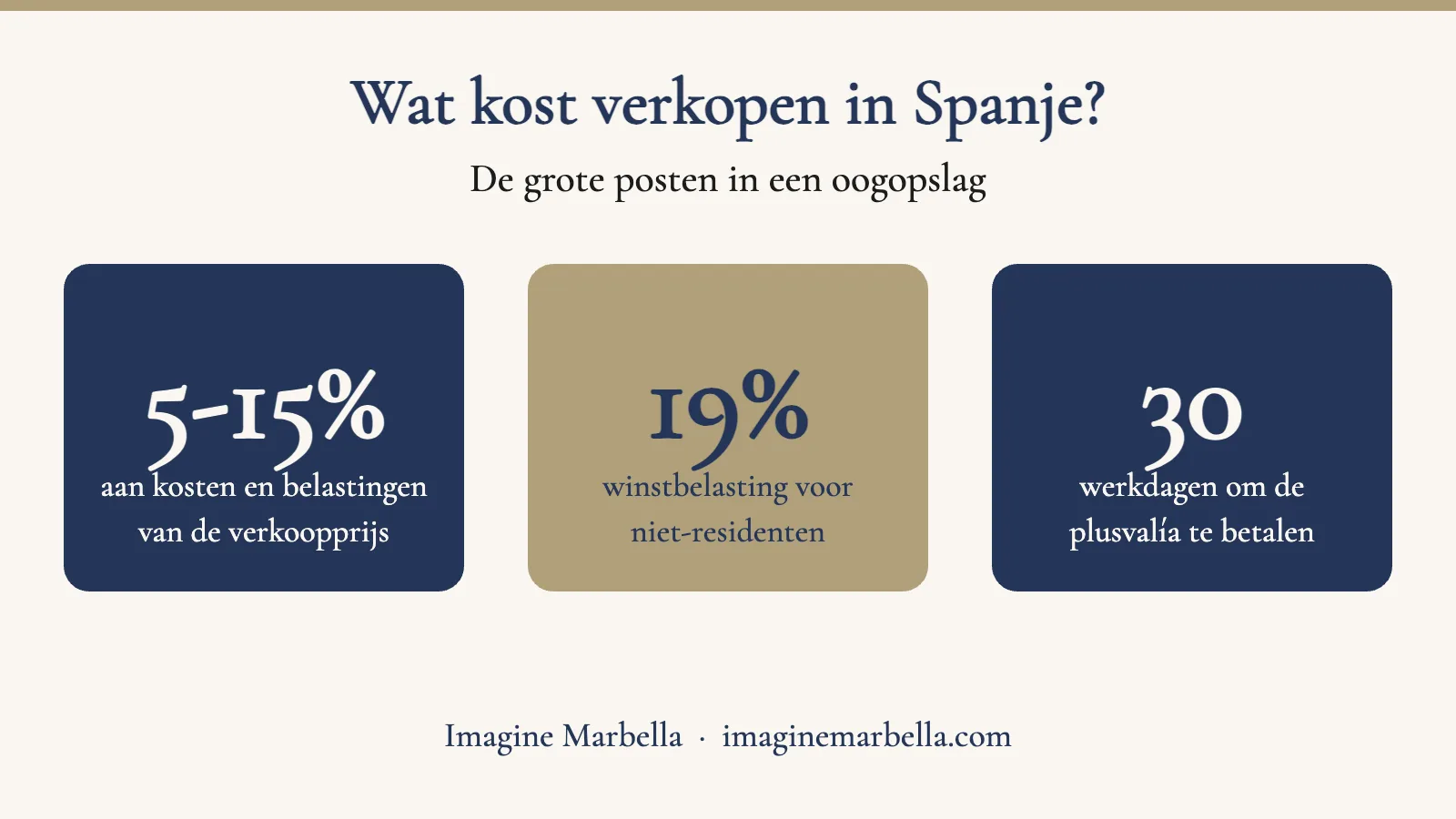
Short answer: budget in total for roughly 5% to 15% of the sale price in costs and taxes, depending on your situation. The largest item is often capital gains tax, followed by the estate agent. The municipal plusvalía, an energy certificate, cancelling a mortgage and the community of owners' paperwork also count.
Selling your home is exciting. But the question everyone asks is: what will I actually keep? Here you'll find every item listed, honestly and without surprises, so you decide on figures rather than uncertainty.
Costs by stage
Before the sale: get your paperwork in order
| Item | Guide amount | Notes |
|---|---|---|
| Energy certificate | approx. 60 to 130 euros | required for a sale, depending on floor area |
| Nota simple (Land Registry information) | approx. 9 euros online | shows ownership and charges on the property |
| Cancelling the mortgage | approx. 400 to 1,000 euros or more | only if there is still a mortgage; your bank and gestor handle the settlement |
| Community of owners certificate (comunidad) | usually a small amount | proves you have no outstanding debts; the Horizontal Property Act requires it for a sale |
When completing the sale
| Item | Guide amount | Who pays |
|---|---|---|
| Reservation or arras contract | often free or a small amount | as agreed |
| Notary and Land Registry | amount depends on the deed | by law the seller pays for the original deed and the buyer for the copy; in practice the parties often agree that the buyer pays everything |
| Agency commission | as per the mandate, plus 21% VAT | the seller |
A detail many sellers don't know: with an arras penitencial (the usual deposit), the buyer loses the deposit if they pull out, and the seller must repay double the deposit if they pull out. This is set out in article 1454 of the Spanish Civil Code, so always have this contract reviewed.
Taxes
| Tax | How it works |
|---|---|
| Plusvalía municipal | municipal, within 30 working days of the deed; zero if there is a loss. With a non-resident seller, the buyer withholds it from the price. Fully explained |
| Capital gains tax (19% for non-residents) | on your gain; the buyer withholds 3%. Fully explained |
| IBI (annual property tax) | split pro rata to the period of ownership, as agreed |
What is deductible?
Many of these costs reduce your gain, and therefore your capital gains tax:
- the the agent's commission (with an invoice),
- the plusvalía paid,
- the cost of cancelling the mortgage,
- the cost of the community certificates.
On the purchase side, your buying costs (tax, notary, Land Registry, lawyer) and documented improvements also count. Mortgage interest does not. Keep all invoices.
How to calculate your net proceeds
- Start with the sale price.
- Deduct the the agent's commission (including VAT).
- Deduct the mortgage that is still outstanding.
- Deduct the plusvalía paid .
- Deduct the capital gains tax (for non-residents: modelo 210, minus the 3% already withheld).
- Deduct the small costs (energy certificate, nota simple, community certificate).
What remains is what you take home. We put this on paper beforehand, based on your figures, so you can see straight away whether now is a good time to sell.
Worked example: what do you keep?
A fictional example, using the same figures as our article on tax as a non-resident. You sell an apartment for 450,000 euros. There is still a 100,000 euro mortgage on it. The agent and plusvalía cost 20,000 euros together, the small paperwork 500 euros. Your taxable gain is 100,000 euros (see that article).
| Item | Amount in euros |
|---|---|
| Sale price | 450.000 |
| Repay mortgage | minus 100,000 |
| Agent and plusvalía | minus 20,000 |
| Small paperwork (certificates, nota simple) | minus 500 |
| Capital gains tax 19% of 100,000 | minus 19,000 |
| Net for you | 310.500 |
You pay the 19,000 euros of tax in two parts: the buyer withholds 13,500 euros (3%) at the deed, and you pay the remaining 5,500 euros later with modelo 210. So the gap between the sale price and what lands in your account at the notary is temporarily larger than your final cost. Factor that into your planning.
What happens after the deed?
The deed is signed, but there are still a few deadlines. Here's how to keep track:
| When | What | Who |
|---|---|---|
| At the deed | Buyer withholds 3% (if you are a non-resident) | buyer |
| Within 30 working days | Pay plusvalía to the town hall | you, with your gestor; if you are a non-resident, the buyer with the amount withheld |
| Within 1 month | File modelo 211 and pay the 3% | buyer |
| Within 3 months after that | File modelo 210: declare the gain and pay or reclaim the difference | you, with your gestor |
| After the sale | Transfer or settle utilities, community fees and IBI | you and the buyer |
We list these dates for you as soon as the deed is signed, so you don't miss anything.
Where things often go wrong in practice
- Late plusvalía payment. The 30-working-day deadline is short. Wait too long and you pay fines and surcharges.
- No proof of improvements. A new pool without an invoice doesn't count for the tax authorities.
- Underestimating the net proceeds. Forget the tax and the mortgage and the final amount comes as a shock. A calculation beforehand prevents that.
- Paperwork that doesn't add up. An unregistered extension can delay the sale or push the price down. Sort it out before you sell.
Three ways to keep costs down
- Prepare your file properly. A complete file avoids delays and price negotiations.
- Have both plusvalía methods calculated. The more favourable one applies.
- Keep all your improvement invoices. Every documented amount reduces your gain.
How we help
We guide the entire sale, from valuation to notary, and give you a net calculation in advance. No obligation, in your language.
Want to know what your property is worth and what you keep after tax and costs? We calculate it for free. No strings attached.
Free valuationSend us a WhatsAppRead also: tax when selling as a non-resident, plusvalía municipal, selling a villa in Marbella and selling your property on the Costa del Sol.
This article is part of our guide to tax and law for property in Spain: all the rules for buying, owning, renting out, selling and inheriting in one place, checked every month.

Free sellers' guide 2026
Selling your property in Spain
- The sales process step by step
- The documents you need
- All costs and taxes when selling
- How to get the best price
You get the guide straight away on screen and in your inbox. No spam.
Frequently asked questions
How much does it cost to sell a property in Spain?
Allow roughly 5% to 15% of the sale price in costs and taxes. The exact amount depends on your gain, your mortgage and the municipality.
Who pays the notary when selling?
By law the seller pays for the original deed and the buyer for the copy, unless agreed otherwise. In practice the buyer often covers all notary costs. We set this out in the contract beforehand to avoid any dispute.
Is an energy certificate mandatory?
Yes, when selling a home. It costs roughly 60 to 130 euros and is normally valid for ten years.
Do I have to pay off my mortgage first?
The mortgage is repaid at the deed from part of the sale price. Your bank and gestor handle the settlement, and the costs are deductible from your gain.
What is a community certificate?
A document from the community of owners showing you have no outstanding debts. The law requires it for a sale, and the notary will ask for it.
Can I deduct the costs of selling?
Yes. The agent, plusvalía, mortgage cancellation and community certificates reduce your gain for capital gains tax.
Sources
- idealista news, costs and taxes when selling a home 2026
- Notarios y Registradores, deductible costs on property gains
- Agencia Tributaria, modelo 210
Written by the Imagine Marbella editorial team. Updated October 2026. This is general information, not tax or legal advice: always have your situation checked by a gestor or lawyer.