



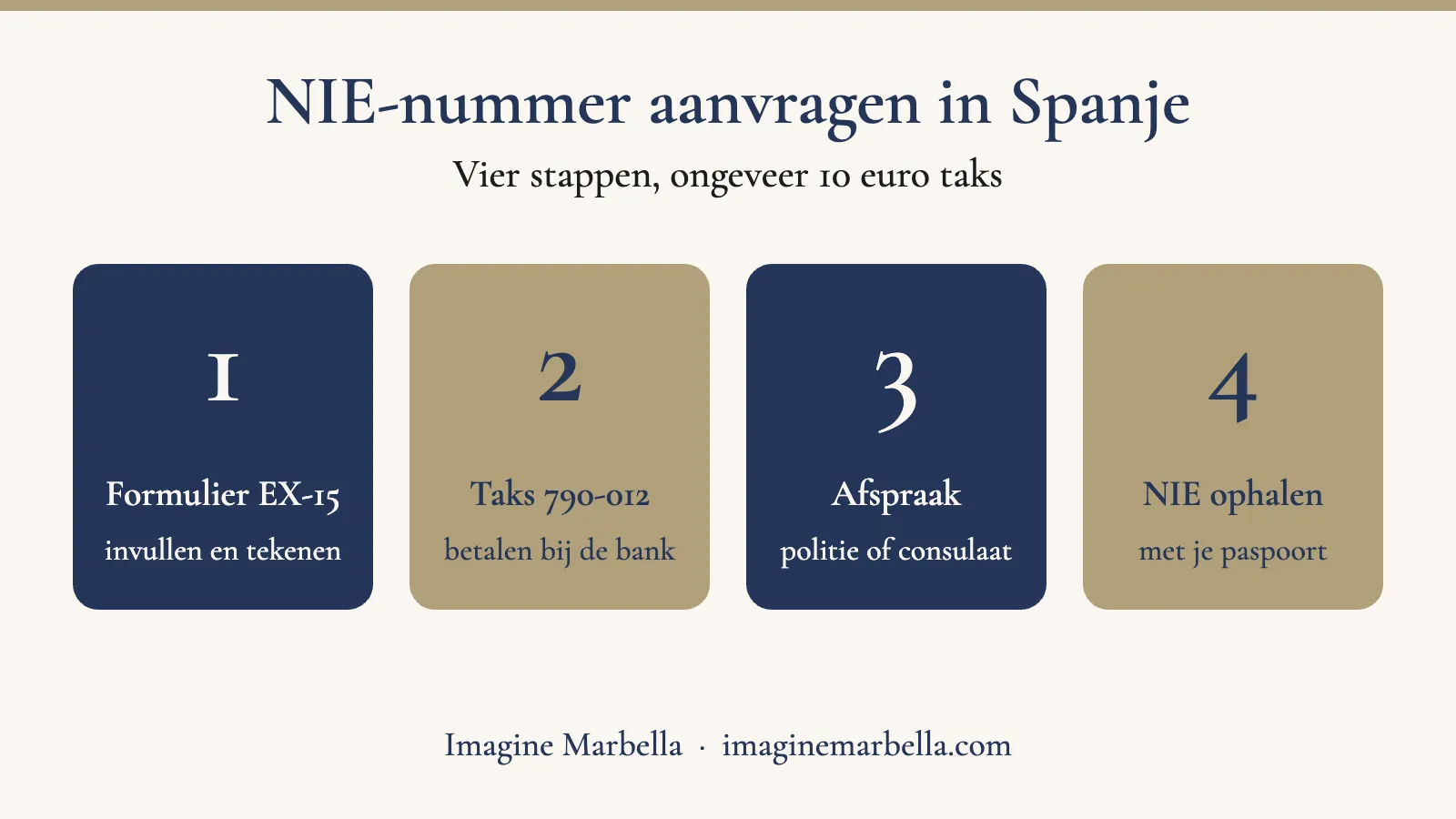
Short answer: a NIE number (Número de Identidad de Extranjero) is your personal identification number in Spain. You need it to buy a property, sign at the notary, open a bank account and pay taxes. You apply with form EX-15 and the paid form 790-012 (about 10 euros), at the police or the foreigners' office in Spain, or at the Spanish consulate in your home country. Allow a few weeks to two months, so start early.
You've found your dream home. The sea-view apartment in Estepona, the villa in Benahavís overlooking the mountains. Then comes the question almost every buyer hears: “Do you have a NIE yet?” Don't panic. It's a small administrative step, but one you should take early . Without a NIE you cannot sign at the notary or open a Spanish bank account.
In this article we explain in plain English what a NIE is, what it costs, where to apply, which documents you need and which mistakes cost you time. Everything has been checked against official sources from the Spanish consulate and the Spanish government, and updated for 2026.
What is a NIE number?
NIE stands for Número de Identidad de Extranjero, the identification number for foreigners. Spanish nationals have a DNI; as a foreigner you have a NIE. The number is personal and unique, and it stays the same even if you move or your situation changes later. The Spanish Tax Agency, notaries, the Land Registry and banks use it to identify you.
A NIE is not the same as a residence permit. It does not give you the right to live or work in Spain. Having a NIE does not make you a Spanish resident. Many buyers find that reassuring: you can become an owner and keep your current residence and tax status.
When do you need a NIE?
Whenever you do anything official in Spain. For property buyers, these are the key moments:
- Signing the deed at the notary. Without a NIE you cannot sign.
- Opening a Spanish bank account, which you need for the purchase and for bills such as water, electricity and local taxes.
- Applying for a mortgage from a Spanish bank. Read more about mortgages in Spain.
- Paying taxes, such as the transfer tax on your purchase and the annual taxes as an owner.
- Connecting utilities in your name.
Our advice: get your NIE before you make an offer. Applying costs little, but the waiting time can add up. That way you are ready when things get serious, and you won't be waiting months for a document while the seller finds another buyer.
How much does a NIE cost?
The official fee is about 10 euros. The Spanish consulate in Amsterdam quotes 9.85 euros per application; other sources quote 9.84 euros. The amount is normally updated every year, so check it when you apply. You pay using form 790, code 012. You fill it in online, print it and pay at a bank. You don't need to be a customer of that bank. Sometimes you can also pay at a cash machine.
Note: the payment receipt is only valid for about three months. So only pay once your appointment is confirmed.
If you use a gestor or lawyer, their fee comes on top. That is a paid service, not a government charge. The amount varies by firm, so ask for a quote in advance.
How to apply for a NIE, step by step
- Choose your route. You can apply in Spain, at the Spanish consulate in your home country, or through a representative.
- Download form EX-15. Only use the official Spanish version, completed and signed. The consulate in Amsterdam does not accept forms from other websites.
- Fill in form 790-012 and pay the fee. Keep the payment receipt.
- Gather proof of the reason. As a buyer this could be a reservation contract, a purchase contract or a mortgage offer. You can also show another economic, professional or social reason.
- Book an appointment (cita previa) with the police or the consulate.
- Attend with your original passport or ID card and copies of everything. You receive your NIE straight away or after a few working days, depending on the office.
Which documents do you need?
| Document | Notes |
|---|---|
| Passport or ID card | Original and a copy |
| Form EX-15 | Completed and signed, official Spanish version |
| Form 790-012 | Completed, with the bank's payment receipt |
| Proof of the reason | For example a purchase contract, reservation contract or mortgage offer |
| Proof of residence in your country | The consulate in Amsterdam, for example, asks for a municipal registration, a letter from the tax office or your driving licence |
Requirements can vary slightly by office and by province. Always check the website of the office where you apply, or let us know and we'll check it with you.
In Spain or through the consulate: what's the difference?
| In Spain (police or foreigners' office) | At the consulate in your country | |
|---|---|---|
| Appointment | Cita previa via the official website | Appointment with the consulate |
| Waiting time | In big cities sometimes four to eight weeks for an appointment | The consulate in Amsterdam normally quotes two weeks after submission; other sources quote six to ten weeks in total |
| Advantage | You're already in Spain for viewings anyway | You sort it out at home before you travel |
| Watch out | Appointments are scarce in busy periods | You must attend in person; the document arrives by email |
Because sources contradict each other on processing times, we'll be honest: allow a few weeks to two months and don't cut it too fine. If you live abroad, you can also apply at the Spanish consulate in your country of residence (in the UK, for example, in London, Manchester or Edinburgh). Book an appointment in advance via the consulate's website.
Many buyers also have the application handled by a gestor or lawyer with power of attorney. That saves you a trip, especially if you're not in Spain yet. To do so, you sign a notarised power of attorney. Your lawyer will tell you which form and which legalisation are needed.
NIE, TIE and residency: don't mix them up
Three terms that are often confused:
- NIE: your number. You get it when you need to arrange something in Spain, such as a purchase.
- Certificado de registro (green A4 sheet): proof of registration for EU citizens who stay in Spain for more than three months. Your NIE is shown on it.
- TIE: the residence card for non-EU citizens, including British citizens since Brexit. Your NIE number appears on it.
Anyone who stays or works in Spain for more than three months must register with the foreigners' office. You automatically receive a NIE at that point, and the consulate can no longer issue one. Planning to move to Spain? That's a separate step with its own conditions.
The five mistakes that cost you time
- A wrong or outdated form. Only the official Spanish version counts.
- Paying too early. The payment receipt expires after about three months.
- No proof of the reason. Without a purchase contract, mortgage offer or other supporting evidence, your application will be refused.
- A name that doesn't match your passport. Write your name exactly as it appears in your passport, including when you sign the deed.
- Paying through a website posing as the government. The fee is about 10 euros. Never pay much more to a website promising a “fast NIE” unless you know who is behind it.
How we help
We help you with every step towards your purchase, including the paperwork. We explain what you need and can put you in touch with a gestor or lawyer who will handle the NIE application for you. Our team speaks English, Dutch, French and Spanish and works in Marbella, Benahavís and Estepona every day. Get in touch with your question or send us a WhatsApp message. No obligation.
Looking for a property in Spain? We help you from the first viewing to the handover of the keys, including the paperwork. No obligation.
Get in touchSend us a WhatsAppRead also: buying a house in Spain as a foreigner, buying a house in Marbella, a mortgage in Spain, the Marbella property market and houses and villas for sale.
This article is part of our guide to tax and law for property in Spain: all the rules for buying, owning, renting out, selling and inheriting in one place, checked every month.
Frequently asked questions
What is a NIE number?
The Número de Identidad de Extranjero is the personal identification number for foreigners in Spain. You need it to buy, sign at the notary, open a bank account and pay taxes.
How much does a NIE cost?
The official fee is about 10 euros (9.84 to 9.85 euros according to the consulate and other sources), paid with form 790 code 012. The amount is normally updated every year. If you use a gestor or lawyer, you pay for that separately.
Do I need a NIE to buy a house in Spain?
Yes. Without a NIE you cannot sign at the notary or open a Spanish bank account. Ideally, get it before you make an offer.
How long does it take to get a NIE?
It varies. The consulate in Amsterdam normally quotes two weeks after submission. Other sources mention a four to eight week wait for an appointment in large Spanish cities and six to ten weeks through a consulate. Allow a few weeks to two months.
Where do I apply for a NIE?
In Spain at the police or the foreigners' office with an appointment (cita previa), or at the Spanish consulate in your home country. The consulate requires you to attend in person.
Which forms do I need?
Form EX-15, completed and signed, and form 790-012 with the bank's payment receipt. Only use the official Spanish versions.
Is a NIE the same as residency?
No. A NIE is a number, not a right of residence. EU citizens who stay in Spain for more than three months must register, and receive a NIE as part of that process.
Does a NIE expire?
For EU citizens the number remains valid. Do check whether a document you use has its own validity period, such as the fee payment receipt (about three months).
Sources
- Consulado General de España en Ámsterdam, Apply for NIE number (documents, forms, fee of 9.85 euros, procedure)
- idealista news, Applying for a NIE in Spain in 2026: step-by-step guide for expats
- Taxdown, Tasa 790 012: qué es, cómo rellenarla y cuánto cuesta en 2026 (amount 9.84 euros, payment, validity of the receipt)
- Orden PJC/617/2025 (fee rates, cited by Taxdown)
Written by the Imagine Marbella editorial team. Updated October 2026. This is general information, not legal advice: always have your situation checked by a gestor or lawyer.