



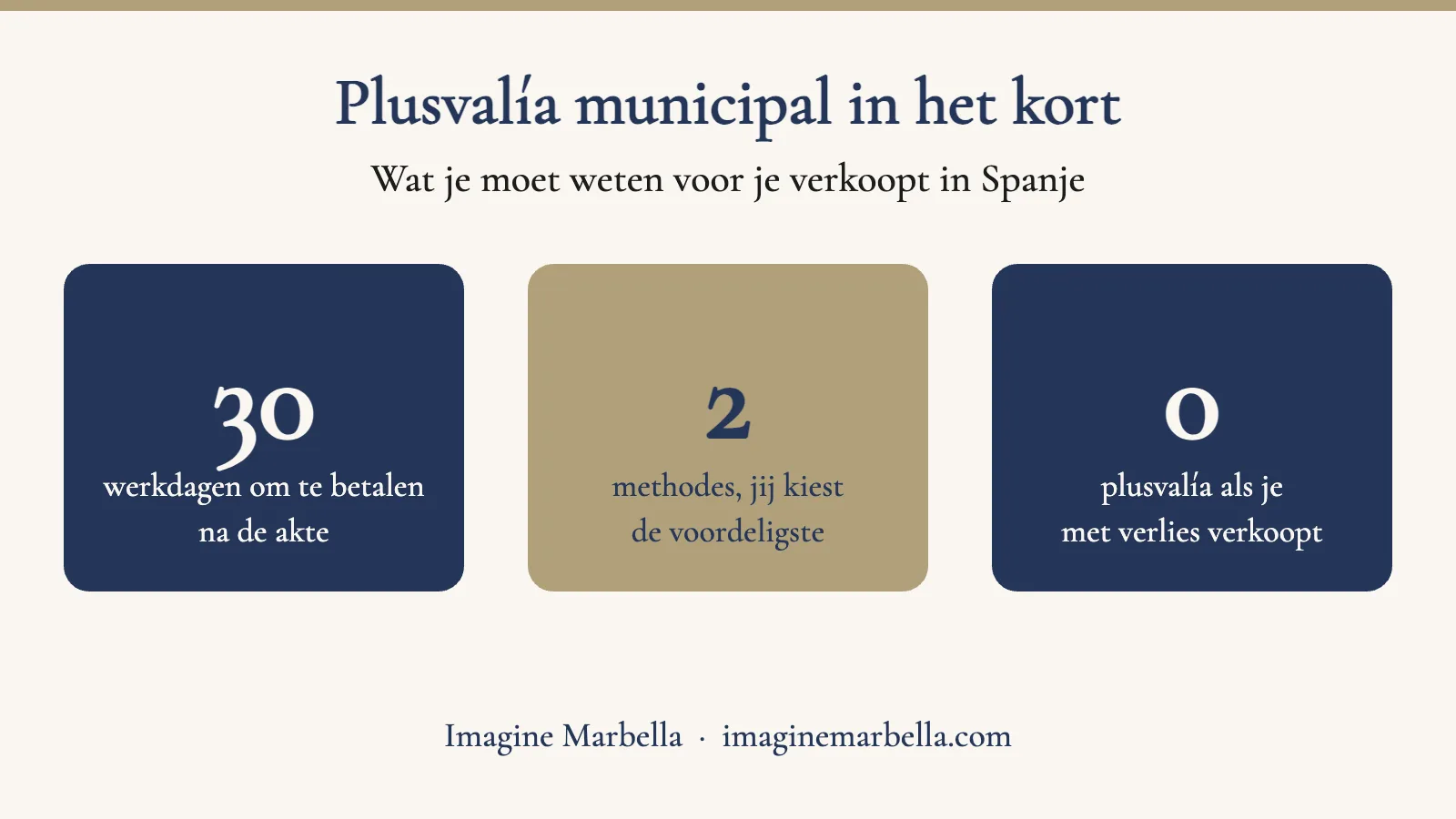
Short answer: the plusvalía municipal is a local tax on the increase in value of the land your property stands on, not on the building. The seller pays it to the town hall where the property is located, usually within 30 working days of the deed. If you sell at a loss, you pay nothing. You choose the more favourable of two calculation methods.
Plusvalía sounds like a tongue-twister, but the idea is simple. Marbella, Estepona or Benahavís become more valuable, and the town hall wants back part of the rise in land value. So when you sell, you pay a local tax. Since the 2021 reform you can choose the more favourable calculation, and if you make a loss you pay nothing.
What exactly is the plusvalía?
The official name is impuesto sobre el incremento de valor de los terrenos de naturaleza urbana. In short:
- It concerns the land, not the house or apartment itself. For an apartment it's a share of the land under the building.
- The town hall collects the tax, not the national tax authority. Each town hall has its own bylaw.
- It is separate from the capital gains tax of 19% you pay to the Agencia Tributaria as a non-resident. You can pay plusvalía without making a profit, or vice versa. Read how capital gains tax works.
Who pays, and when?
| What | Answer |
|---|---|
| Who pays on a sale? | the seller |
| To whom? | the town hall where the property is located |
| Deadline | 30 working days after the deed |
| Non-residents too? | yes, but then the buyer pays it on your behalf and withholds the amount from the price |
| At a loss? | you pay nothing |
Are you a non-resident seller? Then the buyer is legally your substitute taxpayer (sustituto del contribuyente, article 106 of the Local Taxes Act). They withhold the plusvalía from the price at the deed and pay it to the town hall. So the cost is still yours, but the buyer handles the payment. In some municipalities you file a self-assessment (autoliquidación); in others the town hall sends an assessment. We check beforehand and make sure payment arrives on time, so you incur no penalty.
How is the plusvalía calculated?
Since the 2021 reform the law provides two methods. You pay under whichever method works out cheaper.
1. The objective method. The town hall takes the cadastral value of the land and multiplies it by a coefficient that depends on how many years you have owned the property. The longer you own it, the higher the coefficient, up to a ceiling after 20 years. The government sets these coefficients as maximums; town halls may use lower values. Note: an increase by decree (Real Decreto-ley 16/2025) applied for only a few weeks, because Congress did not ratify it on 27 January 2026. Your town hall or gestor uses the values in force on the day of the sale.
2. The actual method. Here what counts is your actual gain on the land: the difference between the transfer value and the acquisition value of the land.
On the result you pay the municipal rate. Each town hall sets it in its tax bylaw (ordenanza fiscal), with a legal maximum of 30%.
Worked example
A fictional example to show the principle (real coefficients and rates vary by municipality and year):
| Objective method | Actual method | |
|---|---|---|
| Cadastral value of the land | 80.000 | |
| Coefficient (say 0.20) | 0,20 | |
| Gain on the land | 48.000 | |
| Taxable base | 16.000 | 48.000 |
| Municipal rate (say 30%) | 30% | 30% |
| Plusvalía payable | 4.800 | 14.400 |
In this example you choose the objective method and pay 4,800 euros instead of 14,400 euros. In another situation, for instance if you bought expensively years ago and now sell at a small profit, the actual method wins. If you sell at a loss, the plusvalía is zero. You must be able to prove the loss with your purchase and sale deeds.
Can you deduct the plusvalía?
A useful detail: the plusvalía you pay is a deductible selling cost when calculating your gain for capital gains tax. So keep the receipt. It slightly lowers your 19% tax.
The five smartest things you can do
- Know in advance what you'll pay. Ask us for an estimate for your address before you accept an offer.
- Make sure your paperwork is in order. Purchase deed, cadastral details (referencia catastral) and IBI receipt to hand.
- Have both methods calculated. The gestor always calculates both.
- Put the 30 working days in your diary. Paying late costs fines and surcharges.
- Include the plusvalía in your net calculation. Read also all the costs of selling.
Have you inherited a property?
Then a different deadline applies: for an inheritance you generally have six months from the death, extendable to a year if you request it within the first six months (article 110 of the Local Taxes Act). We're happy to help with the first steps, together with a lawyer.
How we help
We calculate your net proceeds in advance, including plusvalía and capital gains tax, so you know what to expect before you decide. Our team speaks English, Dutch, French and Spanish and works in Marbella, Benahavís and Estepona every day. Ask for a free valuation, or send us a WhatsApp message. No obligation.
Want to know what your property is worth and what you keep after tax and costs? We calculate it for free. No strings attached.
Free valuationSend us a WhatsAppRead also: tax when selling as a non-resident, all the costs of selling and selling a villa in Marbella.
This article is part of our guide to tax and law for property in Spain: all the rules for buying, owning, renting out, selling and inheriting in one place, checked every month.
Frequently asked questions
What is the plusvalía municipal?
A local tax on the increase in value of the land under your property. It is paid on sale, gift and inheritance.
Who pays the plusvalía on a sale?
The seller, to the town hall where the property is located. If the seller is a non-resident, the buyer withholds the amount from the price and pays it on their behalf.
When do I have to pay?
Usually within 30 working days of the deed. For an inheritance, six months after the death.
Do I pay plusvalía if I sell at a loss?
No. If the property sells for less than you paid, there is no increase in value and therefore no plusvalía.
How do I calculate the plusvalía?
In two ways: cadastral land value times a coefficient, or the actual gain on the land. You choose the more favourable.
Do non-residents pay plusvalía too?
Yes. The tax depends on the property and the municipality, not on where you live.
Is the plusvalía deductible?
Yes, as a selling cost when calculating your gain for capital gains tax.
Sources
- idealista news, plusvalía municipal 2026
- Andersen, announced plusvalía coefficients 2026 (Real Decreto-ley 16/2025, December 2025)
- Notarios y Registradores, deductible costs on non-residents' property gains
- Real Decreto Legislativo 2/2004 (Local Taxes Act), articles 104 to 110 (BOE)
- OCU, change in coefficients in January 2026 (Real Decreto-ley 16/2025 not ratified on 27 January 2026)
Written by the Imagine Marbella editorial team. Updated October 2026. This is general information, not tax or legal advice: always have your situation checked by a gestor or lawyer.