


Short answer: as an EU citizen you can buy a property in Spain without a residence permit . You need a NIE number, a Spanish bank account and an independent lawyer . The process has six steps: budget, search, reservation, legal checks, purchase contract with deposit (usually 10%) and the deed at the notary. Allow 8 to 16 weeks from first offer to keys, and roughly 8 to 10% in extra costs on top of the price for a resale property in Andalusia.
Buying a house in Spain sounds like a dream, and it is. But it works differently from back home. There is no standard survey that everyone has to do, the notary doesn't check everything for you and the deposit has its own rules here. If you know the steps, you buy calmly and without surprises.
In this guide you'll find what each step involves, what it costs and where things go wrong in practice. All amounts and rules have been checked against current sources and apply to 2026. A quick note first: we are an estate agency, not a notary or tax adviser. For the legal checks we always recommend your own independent lawyer .
Can you simply buy a house in Spain as an EU citizen?
Yes. As a citizen of the European Union you buy in Spain on the same terms as a Spaniard. You don't have to live there and you need no visa to become an owner. What you do need is a NIE number, because without it you cannot sign at the notary.
A word on the headlines. In 2025 the Spanish government proposed a tax of as much as 100% on home purchases by non-EU buyers. According to The Local (19 October 2026), that tax is not in force and the proposal is stuck: parliament has not dealt with it and the new housing decrees of October 2026 do not include it. It also only concerns buyers from outside the EU, so nothing changes for EU citizens. The so-called golden visa through property has also ended: the government announced its end on 3 April 2025. That does not affect EU citizens, as they do not need a residence permit. British and other non-EU buyers can still buy freely, but need a visa to stay longer than 90 days in any 180.
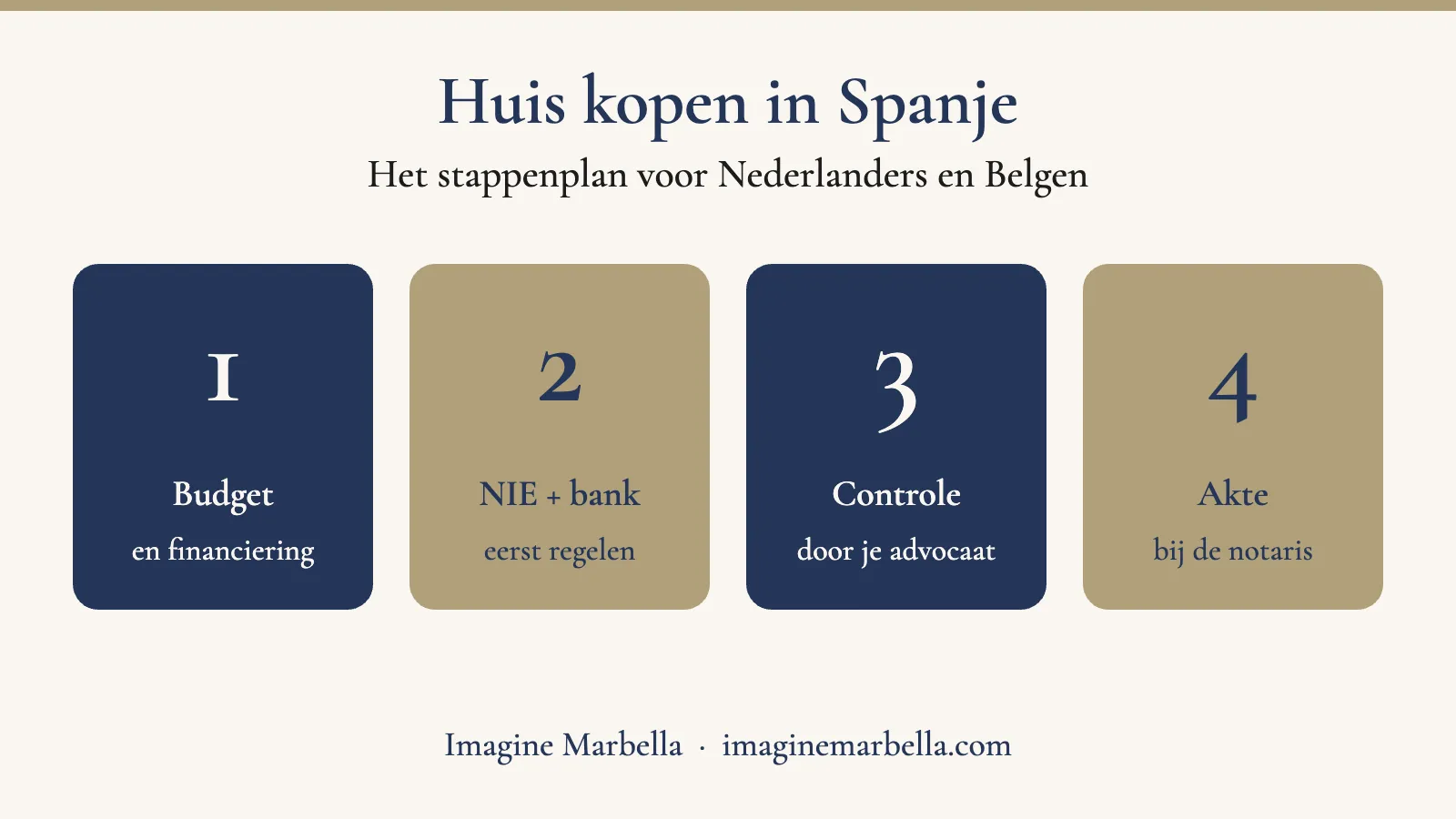
Step 1: set your budget and financing
Don't just budget for the purchase price. On top come taxes and costs (see below), and after that the annual costs of owning a home in Spain. Need a mortgage? Spanish banks usually lend non-residents up to about 60 to 70% of the value. So you need at least 30 to 40% of your own funds, plus the costs. The exact percentage depends on the bank and your profile. Read our article on a mortgage in Spain for more details.
Arrange your financing before you make an offer. A mortgage offer can take weeks, and sellers prefer a buyer who can close quickly.
Step 2: get your NIE and a Spanish bank account
These are the two practical basics. The NIE number costs about 10 euros in fees, but the wait can run from a few weeks to two months. You need a Spanish bank account for the payments around your purchase and afterwards for water, electricity, community fees and property tax. For the purchase price the notary accepts a banker's draft (cheque bancario) rather than cash.
Step 3: search, view and get expert guidance
In Marbella, Benahavís and Estepona the market varies enormously by area, from apartments in a complex with a pool to villas in a gated urbanisation. A local agent knows the areas, the prices and the hidden pitfalls. View at least two or three times, at different times of day, and ask about community fees, energy certificates and any planned works.
Looking specifically in Marbella? Read our step-by-step guide for Marbella, with areas and prices. New to us? Browse our houses and villas and apartments and penthouses, or read how the market looks in 2026.
Step 4: reserve the property and have the paperwork checked
Found your property? Then you often first sign a reservation contract with a small deposit. It takes the property off the market for about two to four weeks. During that period you have your lawyer check everything. According to lawyers, this is the step buyers most often skip, and the most important one to avoid a failed purchase.
| What is checked | Why it matters |
|---|---|
| Ownership and charges (nota simple) | Is the seller really the registered owner? Are there mortgages or embargoes on it? |
| Building permits and occupancy certificate | Is everything that's built actually licensed? An illegal extension or pool becomes your problem after the purchase |
| Debts to the community of owners | Unpaid fees often become the new owner's problem |
| Unpaid IBI (property tax) | Same: the receipts must be in order |
| Planning status | Is the property in a zone where you may build or let? |
| Energy certificate | Mandatory for any sale |
With new build off-plan there is extra protection: the developer must guarantee your payments with a bank guarantee or insurance. This is set out in the Building Act (Ley 38/1999, first additional provision). Always ask for it.
Step 5: the purchase contract with deposit (arras)
The next document is the private purchase contract, often a contrato de arras. You pay a deposit, usually up to 10% of the price. This is not a legal maximum, but it is customary. The rule for the most common type (arras penitenciales) is strict but fair:
- If you as the buyer pull out, you lose the deposit.
- If the seller pulls out, they must repay double .
This is governed by article 1454 of the Spanish Civil Code. If you need a mortgage, have a conditional clause included: if you don't get the financing, you get your money back. Such a clause must be stated explicitly in the contract. The contract also sets the deadline for the deed, often two to six months later.
Step 6: the deed at the notary and registration
At the notary you sign the escritura pública. Seller and buyer attend (or are represented under a power of attorney), and the notary checks identities, the payment method and the source of funds. You pay the balance, usually by banker's draft, and receive the keys. The deed is then registered at the Land Registry, which usually takes 30 to 60 days . Then put the utilities in your name.
From first offer to keys, allow 8 to 16 weeks. A cash purchase is faster than one with a mortgage or off-plan.
What does it cost? Taxes and costs on top of the price
| Item | Resale | New builds |
|---|---|---|
| Transfer tax (ITP) | 7% in Andalusia | not applicable |
| VAT (IVA) | not applicable | 10% |
| Stamp duty (AJD) | not applicable | 1,2% in Andalusia |
| Notary | about 600 to 1,200 euros or more | same |
| Land registry | about 400 to 1,000 euros or more | same |
| Gestor or lawyer | about 300 to 1,500 euros; lawyers often charge a percentage of the price | same |
ITP is calculated on the higher of the purchase price and the cadastral reference value. In Andalusia the general rate is 7% for a resale property. Lower rates (6% or 3.5%) only apply to a low-value main residence or to certain profiles, such as buyers under 35. For a second home in Marbella, Benahavís or Estepona, 7% is therefore the rule. Since 2021 Andalusia has applied a single general rate of 7% transfer tax and 1.2% stamp duty on new builds.
Worked example (indicative): for a resale property of 450,000 euros you pay 31,500 euros ITP. With notary, Land Registry and gestor or lawyer you end up at roughly 35,000 to 40,000 euros extra, so about 8 to 9%. For a new build you add 10% VAT and 1.2% stamp duty, so roughly 12 to 13%. idealista gives a general range of 8 to 13% in extra costs.
And afterwards? Also budget for annual costs: property tax (IBI), community fees, waste tax, insurance and, as a non-resident, an annual return on deemed income (modelo 210). Read all about it in our article on tax on a second home in Spain.
Six pitfalls we often see
- No lawyer of your own. The seller's or developer's lawyer does not work for you.
- Not having the paperwork checked before you sign.
- No conditional clause for your mortgage.
- Forgetting the costs. Budget for 8 to 13% extra, not just the price.
- Paying part of the price under the table. The price in the deed must be the real price. Underdeclaring is illegal and will come back to bite you.
- Buying without knowing whether you want to let or are allowed to let. Check the bylaws and rules beforehand.
How we help
We guide you from the first search to the handover of the keys, in English, Dutch, French or Spanish. We help find what suits you, accompany the viewings, put you in touch with a reliable lawyer and gestor, and follow the file through to after the deed. Our team works in Marbella, Benahavís and Estepona every day. Tell us what you are looking for and we'll gladly help you think it through. No obligation.
Want to buy a property in Marbella, Benahavís or Estepona? Tell us what you're looking for and we'll start searching for you. No obligation.
Tell us what you are looking forSend us a WhatsAppRead also: buying a house in Marbella, Apply for NIE number, a mortgage in Spain and the Marbella property market.
This article is part of our guide to tax and law for property in Spain: all the rules for buying, owning, renting out, selling and inheriting in one place, checked every month.
Frequently asked questions
Can I buy a house in Spain as an EU citizen?
Yes. As an EU citizen you need no visa or residence permit to become an owner. You do need a NIE number and a Spanish bank account.
How much in extra costs comes on top of the price?
For a resale property in Andalusia, roughly 8 to 10%: 7% transfer tax (ITP) plus notary, Land Registry and gestor or lawyer. For a new build it's 10% VAT and 1.2% stamp duty, so about 12 to 13%.
How much deposit do I pay?
With the private contract (arras) it is usually up to 10% of the price. If the buyer pulls out, they lose the deposit. If the seller pulls out, they must repay double.
How long does it take to buy a house in Spain?
On average 8 to 16 weeks from first offer to keys. A cash purchase is quicker. After that, registration at the Land Registry often takes 30 to 60 days.
Do I need a lawyer?
It's not a legal requirement, but it is strongly recommended. Your own independent lawyer checks ownership, charges, licences and debts before you sign.
Can I get a mortgage in Spain as a non-resident?
Yes, from Spanish banks. They usually lend about 60 to 70% of the value, so you need 30 to 40% of your own funds plus the costs.
What is the 100% tax for foreign buyers?
A 2025 proposal by the Spanish government for buyers from outside the EU. According to The Local, it was not in force in October 2026 and remained stuck in parliament. It does not apply to EU citizens.
Do I have to live in Spain to buy?
No. You can be an owner and keep living in your home country. If you do want to move there, there are extra steps, such as registering as an EU citizen after three months.
Sources
- idealista news, 12 steps to buying a house in Spain and Total costs of buying property in Spain 2026
- Costa Luz Lawyers, Buying property in Spain as a non-resident, 2026: full process and Conveyancing timeline 2026
- OCU, Contrato de arras penitenciales (artículo 1454 del Código Civil)
- Guiafiscal.es, ITP-AJD Andalucía 2026 and Interforo Abogados, Impuestos al comprar una vivienda en Andalucía 2026 (13 April 2026), based on Ley 5/2021
- The Local, Will Spain’s 100 percent property tax on foreign buyers ever pass? (19 October 2026) and Reuters via MarketScreener (27 March 2026)
- Fotocasa, Golden Visa in 2026: what has changed
Written by the Imagine Marbella editorial team. Updated October 2026. This is general information, not legal advice: always have your situation checked by a gestor or lawyer.