



Short answer: before you buy a property in Spain, have an independent lawyer check that the seller really is the owner and that there are no mortgages or seizures on it (via the nota simple), that what has been built is licensed and matches the land registry, that there are no debts to the community of owners, IBI or utility companies, and that you may use the property as you want, for example to rent it out. If the seller is a non-resident, you as the buyer must withhold 3% of the price and also pay the plusvalía paid on the seller’s behalf. Only when everything is in order do you sign the purchase contract with a deposit.
In Spain the notary protects you at the deed, but does not check everything. What happens before the deed is your responsibility. That is why buyers on the Costa del Sol have the paperwork checked by their own independent lawyer. In this article you learn what the lawyer checks, which documents you should see and where things go wrong in practice.
You can read the full step-by-step plan for a purchase in buying a house in Spain as a foreigner. You will find all taxes and rules in our tax and law guide.
1. Ownership and charges: the nota simple
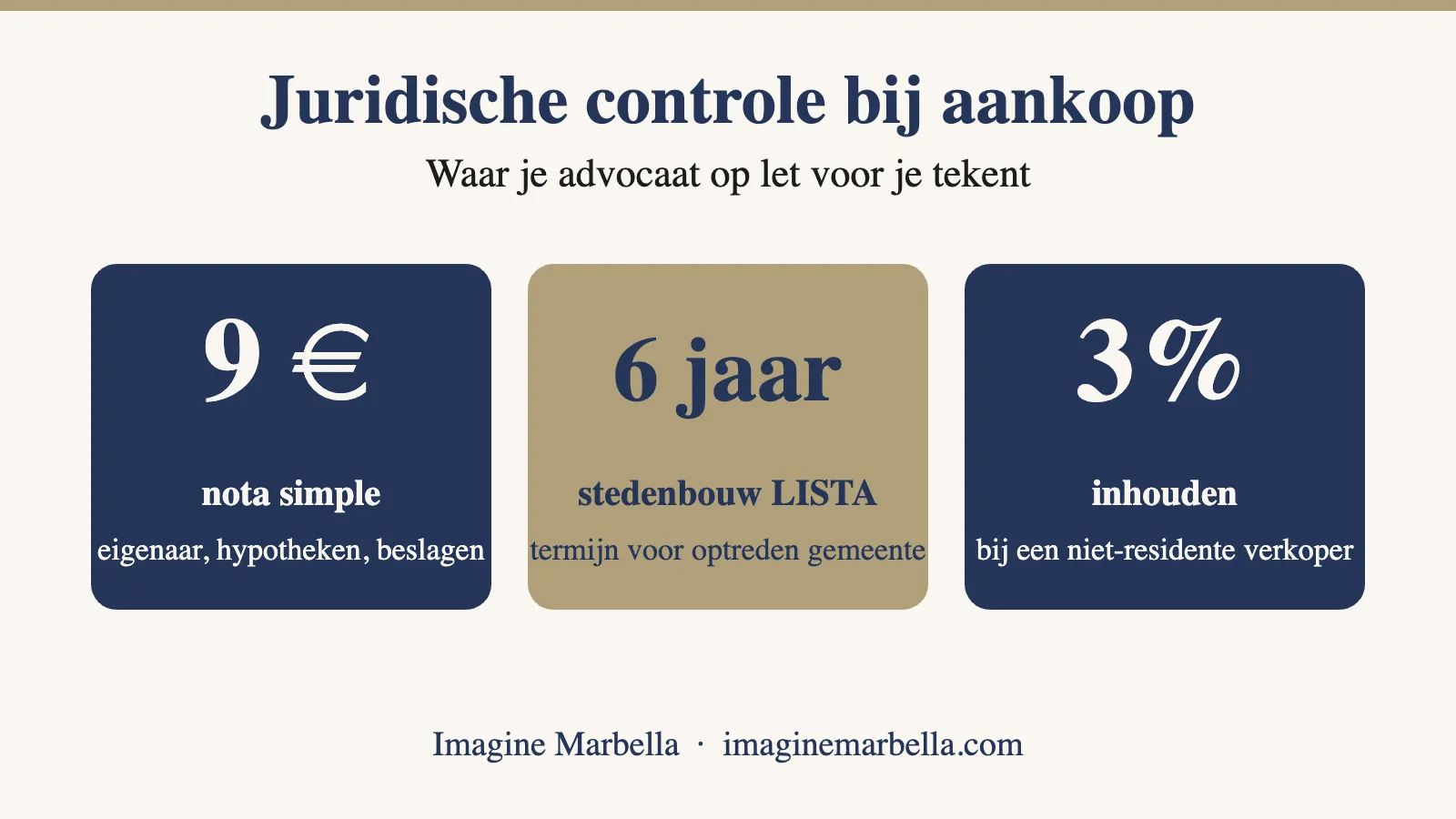
A nota simple is an extract from the land registry (Registro de la Propiedad). You can request it online from the registradores for about 9 euros. It shows:
- who the owner is, and whether that matches the seller;
- the description of the property and its floor area;
- the charges: mortgages, embargoes, easements or other restrictions.
If there is still a mortgage, it must be repaid and cancelled at the deed. Request the nota simple shortly before paying the deposit and again just before the deed. On the day of the deed the notary checks the current status with the registry.
2. Cadastre versus reality
The land registry for tax purposes (Catastro) is a tax register, separate from the Land Registry. Your lawyer compares the cadastral reference and the floor area in the cadastre, in the registry and in reality. Differences are common: an enclosed terrace, a pool or a guest house that isn't recorded anywhere. That can affect the price, the mortgage and a later sale.
3. Licences and planning
Whatever has been built must be licensed. In Andalusia the planning law LISTA (Ley 7/2021) applies. The town hall can take action against an unlicensed construction up to six years after full completion, with exceptions set out in the law. Once that period has passed, the property can often be recognised as asimilado a fuera de ordenación (AFO). It can then remain, but major renovations are restricted.
- New builds: ask for the building licence and the licencia de primera ocupación (or the declaration that replaces it) from the town hall.
- Resale property: in Andalusia a resale generally doesn't require a new occupancy certificate. Your lawyer does check whether extensions are licensed.
- Rural land: be extra careful with properties on non-buildable land (suelo rústico).
- Near the sea: for properties right on the beach, the Coastal Act (Ley de Costas) may impose restrictions.
4. Debts that can stay attached to the property
| What | Which document | Why |
|---|---|---|
| Community of owners | certificate confirming no debts, latest minutes (actas) | the law requires this certificate for a sale; planned special levies (derramas) show up in the minutes |
| IBI | latest receipt | unpaid property tax can remain attached to the property |
| Utilities | latest water and electricity bills | to arrange transfer and final settlement |
| Mortgage | nota simple and the bank's redemption statement | the mortgage must be repaid at the deed |
5. Is the seller a non-resident? Then you have two obligations
- Withhold 3%: you withhold 3% of the price and pay it to the Spanish Tax Agency within a month with modelo 211. If you don't, the property itself remains liable for that amount.
- Plusvalía: with a non-resident seller you are legally the substitute taxpayer (sustituto del contribuyente). You withhold the amount from the price and pay it to the town hall.
Your lawyer or the notary calculates both amounts in advance and records them in the deed. Also read tax when selling as a non-resident and plusvalía municipal.
6. Can you use the property the way you want?
- Renting out: if you want to let to tourists, check the bylaws, the owners' approval and municipal rules. Read holiday rental licence in Andalusia.
- Renovating: if you plan major works, check beforehand what the town hall and the community of owners allow.
- Energy certificate: the seller must provide it. It also gives you an idea of energy use.
7. Off-plan new builds: your payments protected
If you buy off-plan, the developer must guarantee every payment with an individual bank guarantee or insurance policy per buyer (Ley 38/1999). Your lawyer checks the building licence, the guarantee, the payment schedule and the completion date. Also read buying a new build in Marbella.
The purchase contract with deposit
Only once the checks are clear do you sign the purchase contract with deposit (contrato de arras), usually 10% of the price. With the usual type (arras penitenciales, article 1454 of the Spanish Civil Code) you lose the deposit if you pull out, and the seller repays double if they pull out. Include the conditions you need, such as obtaining a mortgage.
Checklist for buyers
- Use your own lawyer, not the seller's or the developer's.
- Have the nota simple requested and compared with the cadastre.
- Check licences, especially for pools and extensions.
- Ask for the community certificate, the minutes and proof of IBI.
- If the seller is a non-resident: have the 3% and the plusvalía withheld.
- If you want to let: check the bylaws, owners and town hall.
- For new builds: insist on the bank guarantee for your payments.
- Only sign the deposit contract once everything is in order.
How we help
We work with independent lawyers who speak English, Dutch or French, and we gather all the paperwork in advance with the seller. That way you know where you stand before you make an offer. Tell us what you are looking for, ask about a property or send us a WhatsApp message. No obligation.
Unsure about a property you've seen? Together with an independent lawyer, we'll look at which documents you need. Free and with no obligation.
Ask your questionSend us a WhatsAppRead also: buying a house in Spain as a foreigner, the costs of buying, applying for a NIE number and our tax and law guide.
This article is part of our guide to tax and law for property in Spain: all the rules for buying, owning, renting out, selling and inheriting in one place, checked every month.
Frequently asked questions
What is a nota simple?
An extract from the Spanish land registry showing the owner, the description of the property and any charges, such as mortgages and seizures. You can request it online for about 9 euros.
Do I need my own lawyer to buy a house in Spain?
It is not compulsory, but strongly recommended. The notary does not check everything, and the seller’s or developer’s lawyer does not work for you.
What if there is an unlicensed extension?
Your lawyer checks whether it can be legalised, and whether the period for the town hall to take action has expired. In Andalusia this is generally six years after completion. After that, AFO recognition is often possible. Have this cleared up before you pay the deposit.
Do I have to withhold anything as a buyer if the seller does not live in Spain?
Yes. You withhold 3% of the price for the Spanish tax authorities (modelo 211) and pay the plusvalía to the town hall on the seller’s behalf.
Do I need a habitation certificate for a resale home in Andalusia?
For a resale in Andalusia, a new certificate is generally not required. For a new build, you ask the town hall for the licencia de primera ocupación.
Can debts of the previous owner pass to me?
Some can, such as arrears to the community of owners and unpaid IBI. That is why you ask for the certificates and proof of payment before the deed.
Sources
- Registradores de España, nota simple informativa (registradores.org)
- Ley 7/2021 de impulso para la sostenibilidad del territorio de Andalucía (LISTA) and Decreto 550/2022, article 355 (six-year period)
- Colegio Oficial de Arquitectos de Málaga, technical note NT.65 on planning enforcement (2026)
- gunnercooke, Habitation certificates across Spain (4 March 2026)
- Real Decreto Legislativo 2/2004, article 106 (buyer as substitute taxpayer for a non-resident seller) and OCU, Comprar una casa a un no residente
- Real Decreto Legislativo 5/2004, article 25 (3% withholding, modelo 211)
- Ley 49/1960 de Propiedad Horizontal, article 9 (community of owners certificate)
- Código Civil, article 1454 (arras)
- Ley 38/1999 de Ordenación de la Edificación, first additional provision (guarantee on payments)
Written by the Imagine Marbella editorial team. Updated October 2026. This is general information, not legal advice: always have your situation checked by an independent lawyer.