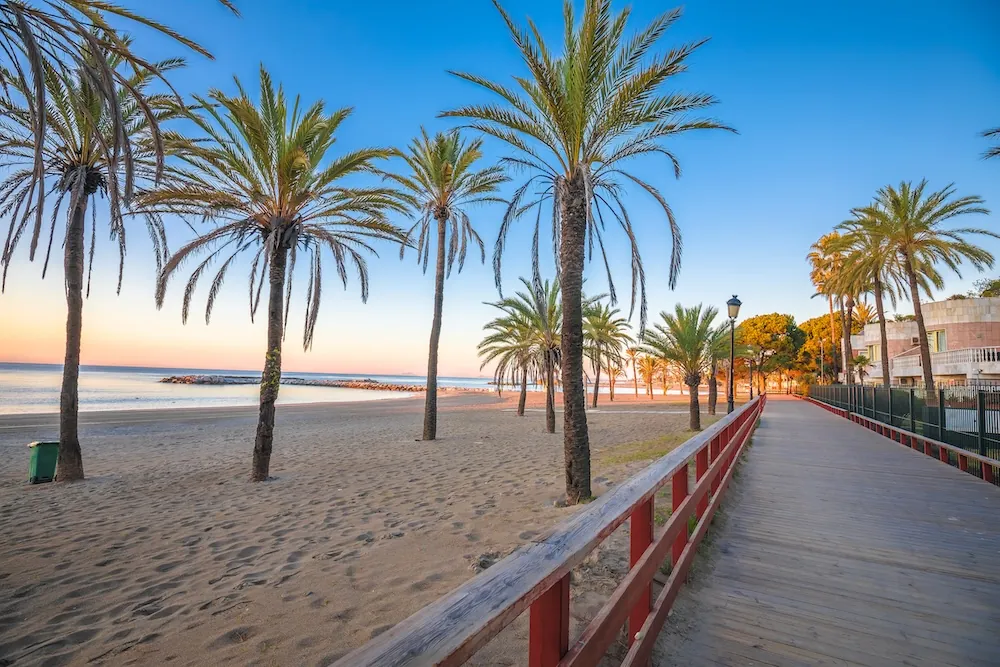



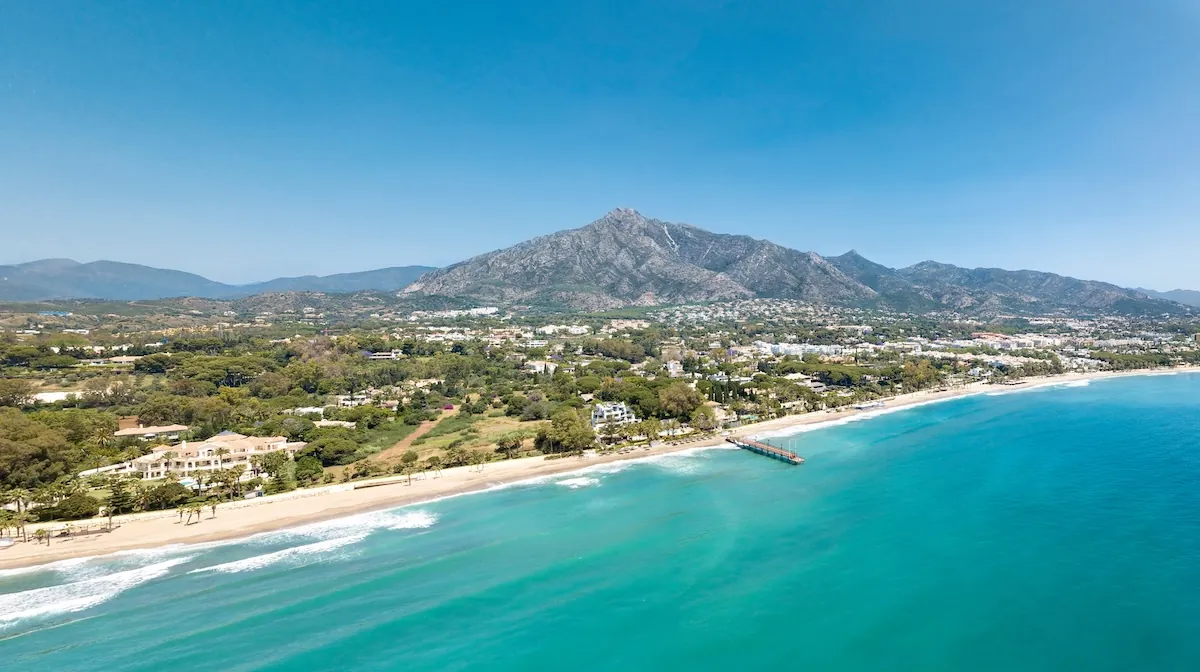
What is the weather like in Marbella? In short: mild in winter, warm but rarely unbearable in summer, and with plenty of sunshine. Marbella has one of the most pleasant climates in Europe, and that is no coincidence. In this article you will find the temperatures month by month, the sea temperature, how much it rains and the best time to come, whether you are going on holiday, want to spend the winter or are looking for a home.
Short answer: Marbella has mild winters (an average of 17 to 18 °C during the day from December to February) and warm, dry summers (28 to 31 °C from June to September). According to the official climate normals from AEMET, the Spanish meteorological agency, it enjoys around 2,900 hours of sunshine and an average of just 42 rainy days a year. The best time to visit for the beach is June to September; for golf and walking, it’s March to May and October to November.
Marbella's climate at a glance
- Summer (June to September): 28 to 31 °C during the day, 18 to 21 °C at night, and there’s almost no rain.
- Winter (December to February): 17 to 18 °C during the day, 7 to 9 °C at night, and there’s the occasional spell of a few rainy days in a row.
- Spring and autumn: 20 to 24 °C, ideal for walking, golf and viewing properties.
- Sunshine: it’s sunny for around 2,900 hours a year, with an average of just 42 days of more than 1 mm of rain.
The weather in Marbella month by month
| Month | Max. temp. | Min. temp. | Sea | Rainy days | Hours of sunshine |
|---|---|---|---|---|---|
| January | 17 °C | 7 °C | 16 °C | 6 | 180 |
| February | 18 °C | 8 °C | 16 °C | 5 | 180 |
| March | 20 °C | 10 °C | 16 °C | 4 | 222 |
| April | 21 °C | 11 °C | 17 °C | 5 | 244 |
| May | 24 °C | 14 °C | 18 °C | 3 | 292 |
| June | 28 °C | 18 °C | 21 °C | 1 | 329 |
| July | 31 °C | 21 °C | 23 °C | 0 | 347 |
| August | 31 °C | 21 °C | 23 °C | 1 | 316 |
| September | 28 °C | 19 °C | 22 °C | 2 | 255 |
| October | 24 °C | 15 °C | 20 °C | 4 | 215 |
| November | 20 °C | 11 °C | 18 °C | 6 | 172 |
| December | 18 °C | 9 °C | 17 °C | 7 | 160 |
| Year | 23 °C | 14 °C | 19 °C | 42 | 2.905 |
Air temperature, rainy days (at least 1 mm) and hours of sunshine: AEMET, 1981-2010 climate normals from the Málaga Aeropuerto weather station, the nearest official station with a long measurement record. Sea temperature: averages for Marbella according to seatemperature.org. Thanks to the Sierra Blanca, Marbella itself is often slightly milder, and individual days can differ from the average.
The weather in Marbella month by month
Weather in Marbella in January
January is the coldest month, with an average of 17 °C during the day and around 7 °C at night. With some 180 hours of sunshine and 6 rainy days, you still get plenty of clear, sunny days, ideal for walking or a round of golf.
Weather in Marbella in February
In February, daytime temperatures average 18 °C, dropping to 8 °C at night. The almond trees are in blossom, and it’s one of the driest winter months, with an average of 5 rainy days.
Weather in Marbella in March
In March, temperatures climb to 20 °C during the day and 10 °C at night. With 222 hours of sunshine, it’s a lovely month for an early spring break or for viewing properties.
Weather in Marbella in April
April brings an average of 21 °C during the day and 11 °C at night. The sea is still cool (17 °C), but out on the terrace it often already feels like summer. Around Easter it gets busy because of Semana Santa.
Weather in Marbella in May
In May it reaches 24 °C during the day and 14 °C at night, with almost 300 hours of sunshine and just 3 rainy days. For many, it’s the best month of all: warm, green and still peaceful.
Weather in Marbella in June
June marks the start of summer: 28 °C during the day, 18 °C at night and a sea temperature of 21 °C. There’s hardly any rain.
Weather in Marbella in July
July and August are the hottest months: an average of 31 °C during the day, 21 °C at night, and the most sunshine of the year (347 hours). A sea breeze keeps the heat bearable on the coast. The sea reaches 23 °C.
Weather in Marbella in August
In August, daytime temperatures average 31 °C, with 21 °C at night. The sea is at its warmest (23 °C). When a hot wind blows in from inland, the terral, temperatures can climb above 35 °C for a few days.
Weather in Marbella in September
September still feels like summer: 28 °C during the day, 19 °C at night and a sea temperature of 22 °C. From mid-September the beaches quieten down, which makes this month a favourite with many Belgian and Dutch visitors.
Weather in Marbella in October
In October, daytime temperatures average 24 °C, dropping to 15 °C at night. The sea is still 20 °C, so swimming is still very pleasant. The first autumn showers arrive, on 4 days on average.
Weather in Marbella in November
November brings 20 °C during the day and 11 °C at night. It's one of the wettest months (6 rainy days), but in between it's often sunny and mild. This is when many winter visitors arrive.
Weather in Marbella in December
In December, daytime temperatures average 18 °C, with 9 °C at night. With 160 hours of sunshine it's the darkest month, but still far sunnier than Belgium or the Netherlands.
Why is the weather in Marbella so good?
Marbella is sheltered behind the Sierra Blanca, a mountain range more than 1,200 metres high. These mountains hold back the cold north wind. On top of that, the Mediterranean moderates the temperature: in summer a sea breeze cools the coast, and in winter the sea keeps the nights mild. The result is a microclimate of its own that is noticeably milder than in many other coastal towns. In our article on Marbella's microclimate you can read all about it.
How warm is Marbella in winter?
Winter is Marbella's real trump card. In December, January and February, daytime temperatures average 16 to 18 °C, and on sunny afternoons you can often eat outside on a terrace in your T-shirt. The coldest month is January, with nights of around 7 °C. Frost is almost unheard of on the coast. It rains more in winter than in summer, but usually in short spells of two to three days, after which the sun comes back out.
That makes Marbella one of the most popular destinations for wintering in the sun. More and more Northern Europeans spend the winter months here, or buy a home to escape the grey northern skies.
Can you spend the winter in Marbella?
Absolutely. If you are wintering here, it is best to choose a south-facing home with plenty of sun, good insulation and some form of heating, as Spanish homes are mainly built to keep the heat out. A modern new build with underfloor heating and a heat pump is ideal in winter. Location matters too: homes on the coast are slightly milder in the evening than homes high up in the mountains.
How hot does it get in summer?
In July and August, daytime temperatures rise to an average of 31 °C. Thanks to the sea breeze, the coast feels more comfortable than inland, where Seville or Córdoba can easily reach 40 °C. Now and then a hot wind from inland, the terral, pushes temperatures above 35 °C for a few days. In August the sea’s temperature reaches around 23 °C.
When is the best time to visit Marbella?
- For the beach and the sea: June to September.
- For golf, walking and sightseeing: March to May and October to November.
- For viewing properties: all year round, but especially in spring and autumn. It is pleasantly warm, there is less traffic and you can see how a property feels outside the high season.
- For wintering: November to March.
When does it rain the most?
The wettest months are October to January. In autumn there can occasionally be short, heavy thunderstorms. In June, July and August barely a drop falls. According to AEMET, the region has on average 42 days a year with at least 1 mm of rain.
The climate as a reason to buy in Marbella
For many of our clients, the weather is the main reason to buy a home on the Costa del Sol. You can live outdoors all year round, play golf, go walking and enjoy your terrace. That also makes a home in Marbella attractive for letting outside the high season. Curious to see what is for sale? Explore our Prestige collection, our new developments or request a personal selection.
What should you pack for Marbella?
- In summer: light clothing, high-factor sun cream, a hat and sunglasses. A thin cardigan for evenings by the sea.
- In spring and autumn: layers. A T-shirt by day, a jumper or light jacket in the evening.
- In winter: a warm coat for the evening, but also sunglasses and sun cream. The winter sun is stronger than you think.
Sunshine and health
The sunny climate has a positive effect on many people's wellbeing. More daylight, more time outdoors and more exercise are reason enough for many to spend part of the year in Marbella. Do protect yourself well from the sun, though: UV levels are high in spring and autumn too.
Frequently asked questions
What is the coldest month in Marbella?
January, when daytime temperatures average 17 °C and it’s around 8 °C at night.
How warm is it in Marbella in December?
On average it’s 18 °C during the day and 9 °C at night. On sunny days it feels even warmer on a sheltered terrace.
Can you still swim in Marbella in October?
Yes. The sea’s still around 20 °C in October, and early in the month air temperatures climb above 25 °C.
Is the weather in Marbella better than in Málaga?
The differences are small, but thanks to the Sierra Blanca, Marbella is better sheltered from the wind and often has slightly milder winters.
How many hours of sunshine does Marbella get a year?
According to AEMET's climate normals (Málaga Aeropuerto weather station), an average of 2,905 hours a year, with July the sunniest month (347 hours) and December the darkest (160 hours).
What is the warmest month in Marbella?
July and August, with average daytime temperatures of 31 °C and 21 °C at night. The sea is then around 23 °C.
When does it rain most in Marbella?
In November and December, with an average of 6 to 7 days of rain a month. From June to August there is hardly any rain at all.
Thinking of spending the winter in Marbella? Read wintering in Marbella and what the 183-day rule means for your taxes. You'll find all the rules on buying and owning property in our tax and law guide.
Sources
- AEMET (Agencia Estatal de Meteorología), Valores climatológicos normales, Málaga Aeropuerto, 1981-2010, accessed 23 October 2026
- seatemperature.org, average monthly sea temperature in Marbella, accessed 23 October 2026
Updated October 2026 by the Imagine Marbella editorial team.