



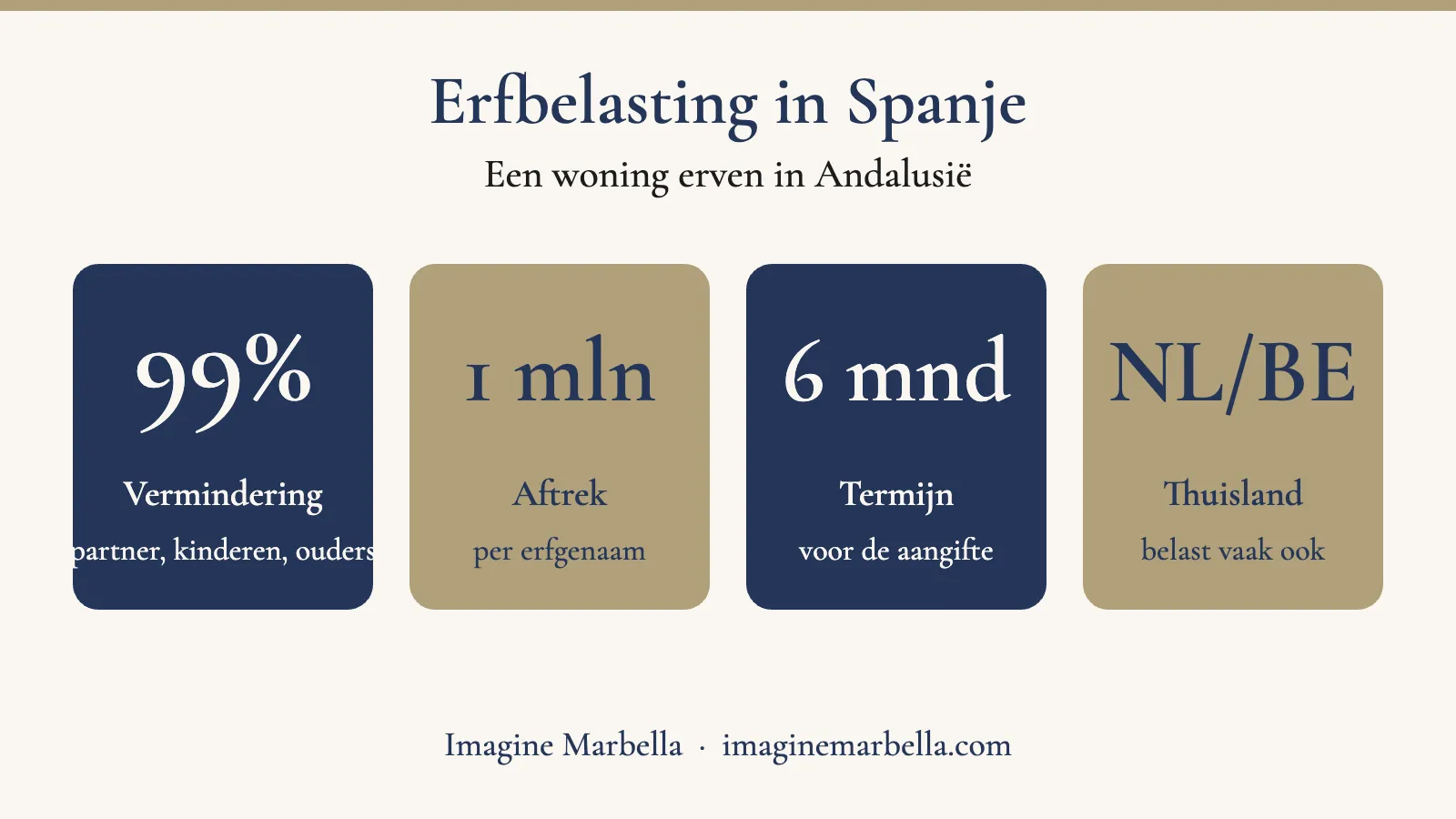
Short answer: if you inherit a property in Spain, you as the heir pay Spanish inheritance tax (Impuesto sobre Sucesiones), even if you don't live in Spain. For a property in Andalusia you can apply the Andalusian rules . Children, spouses and parents receive a 99% relief and an allowance of up to 1 million euros per heir, so many inheritances are barely taxed. You file within six months of the death. Note: your home country may also tax the inheritance.
Nobody likes to think about it, but if you own a home in Spain it's wise to know what happens on a death. The good news: in Andalusia, home to Marbella, Benahavís and Estepona, inheritance tax for close family has been very low since 2019. The less good news: that advantage can largely disappear if your home country taxes the inheritance itself. And there are deadlines you must not miss.
In this article we set out the rules, checked against 2026 sources. Succession law and inheritance tax are tailor-made, so always have your situation reviewed by a notary or lawyer who knows both countries.
Who pays Spanish inheritance tax?
In Spain it is not the estate that pays, but each heir on what they receive. A property in Spain is always taxed in Spain, even if the deceased and the heirs live abroad.
Non-residents used to pay the (expensive) national rate. After a 2014 ruling by the European Court of Justice, EU heirs may apply the rules of the region where most of the Spanish assets are located. Since 2021 this also applies to heirs from outside the EU. For a property in Marbella, the Andalusian rules apply.
The Andalusian rules in 2026
| Heir | Group | Benefit in Andalusia |
|---|---|---|
| Children under 21 | I | Allowance up to 1 million euros and 99% relief on the tax |
| Children 21 and over, spouse, parents | II | Allowance up to 1 million euros and 99% relief on the tax |
| Brothers, sisters, nephews, nieces, uncles, aunts | III | A smaller allowance, no 99% relief |
| Not related | IV | No allowance, no relief |
For close family (groups I and II), this means many inheritances in Andalusia pass with virtually no Spanish inheritance tax. A 2026 Spanish advisory guide gives the example of a 500,000 euro inheritance by a child from a father who lived in Spain: in Andalusia the tax comes to about 680 euros. Conditions apply: for example, anyone who gets the reduction for the deceased's home must keep that home for three years. Have your situation checked by a tax adviser.
Tax in your home country too?
This is what surprises many families. If the deceased lived in another country, that country often taxes the inheritance too, including the Spanish property.
- Belgium: on the death of a Belgian resident, worldwide assets are taxed in Belgium, including Spanish assets that are almost exempt in Andalusia. There is a credit for foreign inheritance tax on foreign property, but if the Spanish tax is close to zero, there's little to credit.
- Netherlands: the Netherlands also taxes a resident's estate, with rules to avoid double taxation.
So the low Andalusian rate mainly pays off if the deceased lived in Spain, or if the inheritance is treated favourably in your home country. Your notary will calculate exactly how the credit works out, so always take advice in your home country too.
Which succession law applies, and do you need a Spanish will?
Since the 2015 EU Succession Regulation, in principle the law of the country where the deceased had their habitual residence applies. In your will you can also choose the law of your nationality. If you live in Belgium and own a villa in Marbella, Belgian succession law usually applies, including to the Spanish property.
Many advisers recommend a separate Spanish will for your Spanish assets. It considerably speeds up the process with the Spanish notary and bank. Make sure it doesn't conflict with your will at home; your notary can align both wills.
Would you rather pass your property on now? Then read gifting a property in Spain to your children, with a comparison of gifting versus inheritance.
Steps after a death
- Death certificate and certificate of inheritance to gather, with apostille and sworn translation where needed.
- Spanish certificate of last wills from the registry in Madrid, to find out whether there is a Spanish will.
- NIE number for each heir. How to apply for a NIE.
- Acceptance of the inheritance at a Spanish notary.
- Filing and paying inheritance tax within six months of the death. You can request a one-off six-month extension, but before the end of the fifth month.
- Plusvalía municipal to the town hall, also within six months. Read how it works.
- Registration at the Land Registry in the heirs' names.
Plan ahead
- Make a Spanish will for your Spanish assets.
- Have both countries looked at together. Spanish inheritance tax is low in Andalusia, but your home country often decides the real bill.
- Consider the ownership structure when buying: jointly, or already with the children.
- Gifting can be advantageous in some situations, but has its own consequences in Spain and at home. Always have it calculated.
- Selling after an inheritance? Also read our article on tax when selling as a non-resident.
How we help
Have you inherited a property in Spain and want to sell, let or keep it? We value it for free, put you in touch with a notary, lawyer or gestor, and guide the sale or letting. We speak English, Dutch, French and Spanish. Get in touch, even if you first just want to know where you stand. No obligation.
Inherited a property in Spain? We'll value it for free and help you with the next steps. No obligation.
Free valuationSend us a WhatsAppRead also: plusvalía municipal, tax when selling as a non-resident and tax on your second home in Spain.
This article is part of our guide to tax and law for property in Spain: all the rules for buying, owning, renting out, selling and inheriting in one place, checked every month.
Frequently asked questions
Do I pay Spanish inheritance tax if I don't live in Spain?
Yes, on Spanish property such as a home. In Spain each heir pays tax on what they receive, even if they live abroad.
Which rules apply to a property in Marbella?
The Andalusian rules. Since 2014 for EU heirs and since 2021 for all heirs, you can apply the rules of the region where the property is located.
How much inheritance tax do I pay in Andalusia?
Children, spouses and parents get an allowance of up to 1 million euros and a 99% relief, so many inheritances are barely taxed. Siblings and more distant relatives get far less benefit.
What is the deadline for Spanish inheritance tax?
Six months after the death. You can request a one-off six-month extension if you do so before the end of the fifth month.
Do I also pay inheritance tax in my home country?
If the deceased lived in another country, that country often taxes the inheritance too, including the Spanish property. There are rules against double taxation, but always have it checked.
Do I need a Spanish will?
It's not compulsory, but often recommended for Spanish assets. It speeds up the process. Make sure it is aligned with your will at home.
Sources
- BM Consulting, Impuesto de Sucesiones España para extranjeros, 17 CCAA 2026 (Ley 26/2014, Ley 11/2021)
- Tamayo Abogados, Sucesiones Andalucía 2026: bonificación 99%
- Jubel, New inheritance and gift tax exemption in Andalusia (Dutch) (rules since 11 April 2019)
- Test Aankoop, Changes to inheritance tax 2026 (Belgium, Dutch)
- Regulation (EU) No 650/2012 (EU Succession Regulation)
Written by the Imagine Marbella editorial team. Updated October 2026. This is general information, not legal or tax advice: always have your situation checked by a notary or lawyer who knows both countries.