



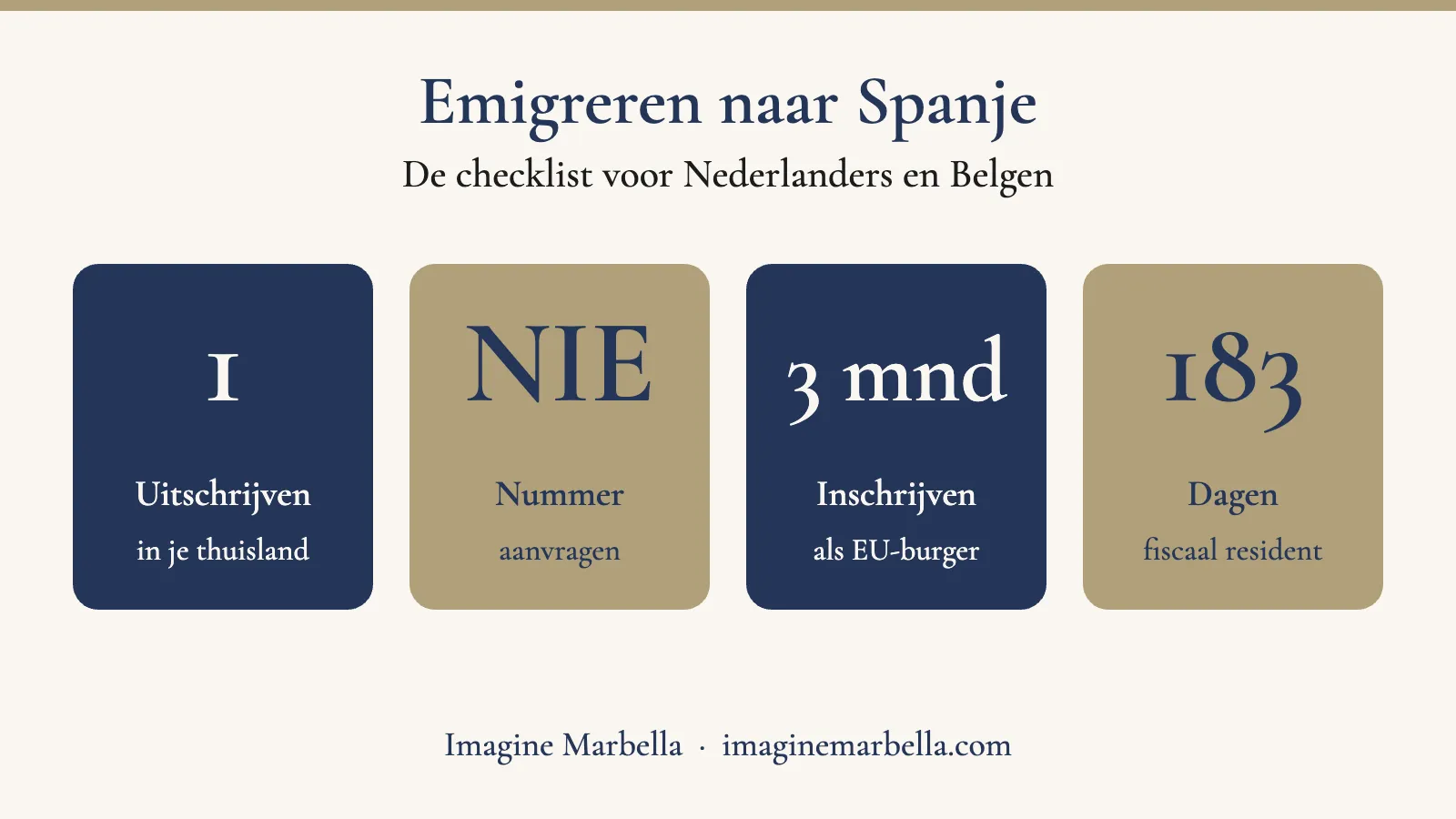
Short answer: as a Dutch or Belgian citizen you do not need to apply for a visa or permit to move to Spain. After three months you register as an EU citizen (the certificado de registro). You must then be employed, self-employed, or, if not working, have sufficient resources and health insurance valid in Spain . You also deregister in your home country, arrange your healthcare and become a tax resident if you spend more than 183 days a year in Spain or your economic interests are there. If you are retiring, pay extra attention to your state pension (AOW) and pension tax.
For many Dutch and Belgian citizens, moving to Spain is less complicated than they think, but it takes more than booking a removal van. You need to deregister, sort out your healthcare and taxes properly, and register in Spain on time. Doing it in the right order avoids unpleasant surprises, such as a reduction in your state pension or double taxation.
This article gives you the order and the main rules, checked against 2026 sources. We are estate agents, not tax advisers. For your personal situation, especially pensions and tax, always talk to an adviser who knows both countries.
Do you need to apply for a visa or permit?
No. As a citizen of the European Union you may live freely in Spain. From three months of residence you register with the foreigners' office or the police and receive the certificado de registro de ciudadano de la UE, often called the green certificate. It shows your NIE and your address. It does not expire, but you must report changes of address.
What you have to prove depends on your situation:
| Your situation | What you need |
|---|---|
| Employee | Employment contract, employer's statement or social security registration |
| Self-employed | Registration as autónomo or in the commercial register |
| Retired or not working | Sufficient resources (bank statements or proof of pension) and health insurance valid in Spain |
| Student | Enrolment, health insurance and a declaration of sufficient resources |
For the application you need form EX-18, your passport or ID card, a recent padróncertificate (town hall registration) and the receipt for the small fee (form 790-012). After 5 years of continuous legal residence you can apply for a permanent residence certificate. The fee for the EU registration certificate is 12 euros (2026 rate). Book an appointment (cita previa) with the police in your area.
Do you have a partner or family member from outside the EU? They need their own residence card. The EU citizen's certificate does not cover them.
The right order: what to arrange when?
The schedule below follows Costaviva's checklist (updated October 2026), supplemented with the sources further down.
| When | What |
|---|---|
| 6 to 12 months before | Choose a region and try living there, including in winter. Have your income and tax position calculated. Start learning Spanish. |
| 3 to 6 months before | Rent for 6 to 12 months first, or buy with an independent lawyer. See our step-by-step guide to buying a house. |
| 2 to 6 months before | Apply for your NIE number . Have documents apostilled and sworn-translated where needed. |
| 1 to 3 months before | Arrange your deregistration and paperwork in the Netherlands or Belgium (see below). |
| First weeks in Spain | Register with the town hall (empadronamiento), open a Spanish bank account, arrange healthcare and put the utilities in your name. |
| After 3 months | Apply for the EU registration certificate. |
| First months | Apply for a digital certificate and Cl@ve, and choose a gestor or tax adviser. |
Deregistering in the Netherlands
- Municipality (BRP): deregister if you expect to live abroad for at least eight months a year. You are then entered in the non-residents register (RNI).
- Tax office (Belastingdienst): report your departure. For the year you leave you file an M return. Benefits stop.
- SVB: report your departure. For every year you are not insured in the Netherlands, your AOW state pension is reduced by 2% . You must apply for voluntary insurance within one year.
- Health insurance: only cancel it once your Spanish cover is in place.
This is the general framework. The details vary by situation, so check with the Belastingdienst and the SVB.
Deregistering in Belgium
- Municipality: as soon as you are resident in Spain, deregister in Belgium. You receive a certificate of removal from the population register, the model 8.
- Health insurance fund (mutualité): first ask your mutualité which documents they need for form E121 or S1.
- Consulate: with model 8 you can register at a Belgian consulate in Spain.
- Still not sure? You can sometimes be registered as “temporarily absent” for up to a year. Ask your municipality.
- Historical address extract: request an international extract with historical addresses, in Spanish, especially if you are bringing a vehicle.
Healthcare: how are you insured in Spain?
Your Dutch basic health insurance ends once you live in Spain. In Spain there are three routes:
- Work in Spain: you are covered by Spanish social security (Seguridad Social).
- Pension from the Netherlands or Belgium: you request an S1 form from your Dutch or Belgian body and register it with the Spanish INSS, after which you receive a Spanish health card.
- Otherwise: private insurance. To register as an EU citizen, insurance valid in Spain is actually mandatory if you are not working.
Tax: when are you tax resident in Spain?
Under Spanish income tax law (article 9 of the IRPF law) you are tax resident if any one of these three applies:
- You spend more than 183 days per calendar year in Spain. Short absences count, unless you can prove you are permanently resident elsewhere.
- The centre of your economic interests is in Spain, for example your business, your investments or most of your assets.
- Your spouse and minor children normally live in Spain. This is a presumption you can rebut, but the burden of proof is on you.
As a resident you pay tax on your worldwide income. As a non-resident you only pay on Spanish income, usually at 19% or 24%. Living in two countries at once? Then the tax treaty decides. Under the Netherlands-Spain treaty, the first criterion is where you have a permanent home , then where your interests are strongest. Anyone who sells their Dutch home and buys one in Spain is usually regarded as Spanish resident. If you keep a house in the Netherlands, the outcome depends on the facts.
As a resident you also file a Spanish return every year (usually between April and June) and must report assets abroad above 50,000 euros using modelo 720 (before 31 March). Want to know what you pay on your Spanish home as a non-resident? Read our article on tax when selling as a non-resident.
Pensions and AOW in Spain
Retiring? Everything about tax, the S1 form and your healthcare is in retiring to Spain. Bringing your car or dog? Then also read moving to Spain with your car and moving to Spain with your dog.
| Type of income | Who may tax it? |
|---|---|
| AOW (Netherlands) | In principle the Netherlands under the treaty. Spain does take it into account for your other income (exemption with progression) |
| Private or occupational pension from the Netherlands | Spain (article 17 of the treaty) |
| Civil service pension from the Netherlands | The Netherlands (article 18) |
| Belgian statutory pension as an employee | Spain, according to a 2025 guide. Civil service pension: Belgium |
Because this differs by type of pension, have your situation checked individually by a tax adviser who knows both countries. In practice: have your AOW and pension paid into an IBAN account and give your new address to the SVB and your pension fund, as they ask for proof of life every year.
Where is the best place to live?
That depends on what you're looking for: golf areas, beaches or village life. Want to know more about living on the Costa del Sol? Read moving to Marbella, wintering in Marbella and international schools in Marbella for families.
Our advice: rent for a while before you buy. That way you get to know the neighbourhood, the weather and the neighbours, and you see what winter is like.
How we help
We help you find a home to rent or buy in Marbella, Benahavís or Estepona, in English, Dutch, French and Spanish. We help you choose the area, guide your purchase and put you in touch with a gestor or tax adviser for the administrative and tax side. Tell us about your plans and we'll look at the next step together. No obligation.
Dreaming of living in Spain? Tell us your plans and we'll help you think about the area, the property and the next step. No obligation.
Tell us your planSend us a WhatsAppRead also: moving to Marbella, Apply for NIE number and buying a house in Spain.
This article is part of our guide to tax and law for property in Spain: all the rules for buying, owning, renting out, selling and inheriting in one place, checked every month.
Frequently asked questions
Do I need a visa to move to Spain?
Not as a Dutch or Belgian citizen. After three months you register as an EU citizen and receive the registration certificate with your NIE.
What do I need to arrange before I leave?
Apply for your NIE, deregister with your municipality, report your departure to the Belastingdienst and SVB (Netherlands) or your mutualité (Belgium), and only cancel your health insurance once your Spanish cover is in place.
When am I tax resident in Spain?
If you spend more than 183 days a year in Spain, if the centre of your economic interests is there, or if your spouse and minor children normally live there. You then pay Spanish tax on your worldwide income.
What happens to my AOW if I move to Spain?
You keep receiving AOW, but it is reduced by 2% for every year you are not insured in the Netherlands. Under the tax treaty, in principle the Netherlands may tax the AOW. Have this checked for your situation.
How am I covered for healthcare in Spain?
Through Spanish social security if you work, with an S1 form if you receive a pension from the Netherlands or Belgium, or otherwise with private insurance.
Do I have to buy a house before I move?
No. Many people rent for six to twelve months first. That way you get to know the area before making a big decision.
What is modelo 720?
An annual declaration of assets abroad above 50,000 euros for Spanish tax residents. The deadline is 31 March. Ask your adviser about the current rules.
Can my non-EU partner come with me?
Yes, but they need their own residence card as a family member of an EU citizen. The EU citizen's certificate does not cover them.
Sources
- Costaviva, Checklist for emigrating to Spain 2026: everything in order (Dutch) (updated October 2026)
- MigrationLex, Registering as an EU citizen in Spain (Real Decreto 240/2007)
- JC Costa Blanca, Emigrating to Spain and deregistering in Belgium (Dutch)
- BM Consulting, Spain tax residency 2026 (article 9 Ley 35/2006)
- International Taxation Spain, Netherlands-Spain double tax treaty guide (May 2026) and ImmoAbroad, Living in Spain with Dutch AOW
- Casas Kimpencio, Taxes on a Belgian pension in Spain (Dutch) (last modified 27 November 2025)
Written by the Imagine Marbella editorial team. Updated October 2026. This is general information, not tax or legal advice: always have your situation checked by an adviser who knows both countries.